Long-Term Weight Regain After GLP-1 Discontinuation
Stopping GLP-1 drugs brings fast regain, and the biology explains why.
GLP-1 receptor agonists produce weight loss by acting on the brain's appetite and reward circuits. They leave the underlying metabolic and neurological machinery that causes and sustains obesity in the first place untouched. That distinction determines what happens the moment someone stops taking the drug, a question the rest of this piece works through in detail.
The appetite-suppression signal travels through two separate routes in the brain. In the area postrema, the same class of drug weakens dopaminergic motivation for high-reward foods, the kind of eating driven less by hunger than by craving. These are not redundant systems. One dials down appetite; the other dials down the pull of food as reward, and together they explain why patients on these drugs report both eating less and wanting less.
GLP-1 is not a molecule the body only encounters through injection. Receptors for it also show up in the substantia nigra, the amygdala, the hippocampus, and the lateral prefrontal cortex, a spread that touches movement, emotion, memory, and executive control. This is a native signaling system the drug amplifies pharmacologically, not a foreign switch it installs.
During active treatment, the drug keeps those receptors occupied around the clock. Nothing about stopping the drug is itself mysterious.
The pace and extent of weight regain after stopping
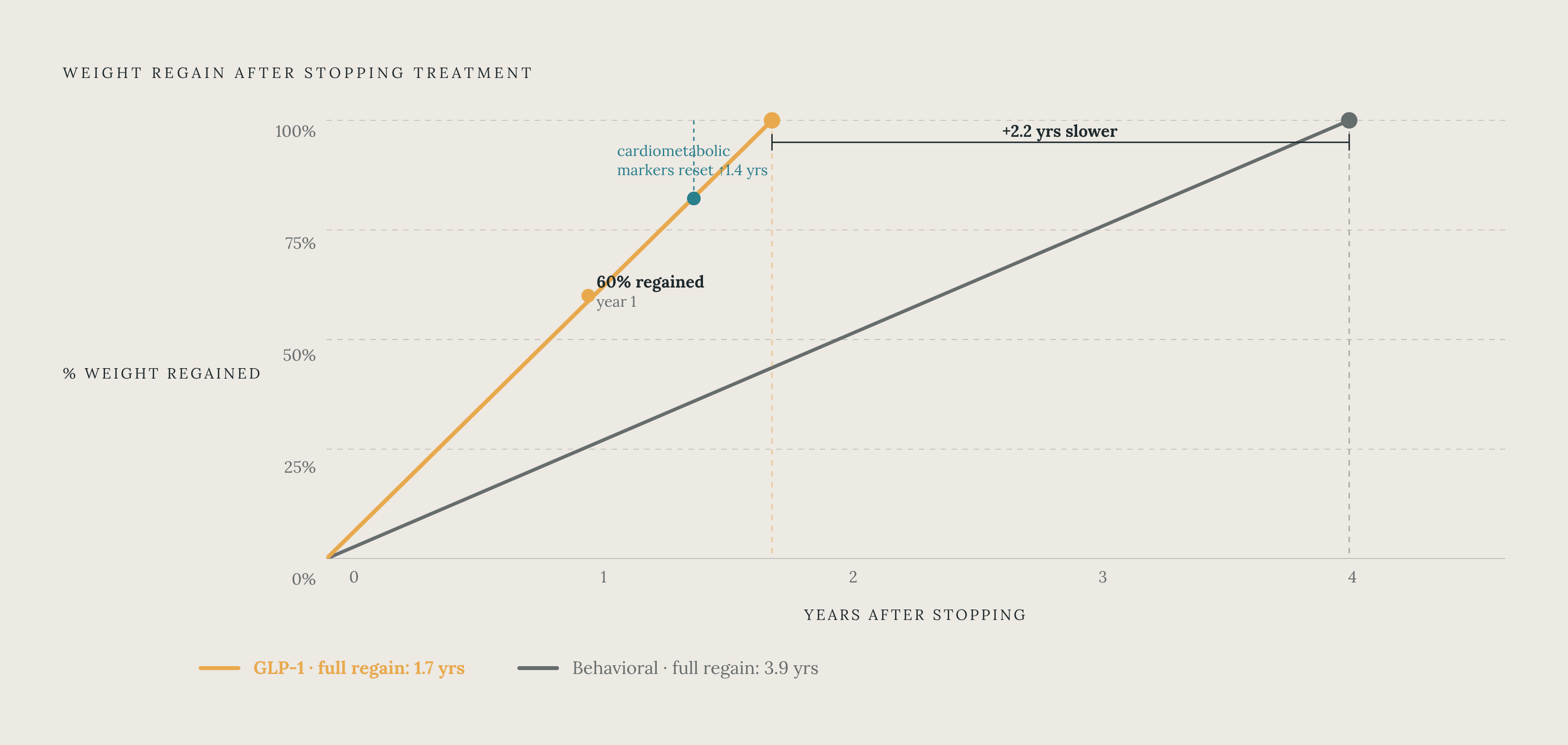
The documented pace of regain after stopping GLP-1 drugs is large enough to change how the entire treatment should be understood. A University of Oxford meta-analysis, pooling data from 37 clinical trials and observational studies, found that people regained weight at an average rate of roughly 0.4 kg per month after stopping, enough to bring them back to their starting weight within about 1.7 years.
That timeline looks very different next to behavioral approaches. The same analysis found that regain after stopping a GLP-1 happens roughly four times faster than regain after stopping a behavioral weight-loss program such as a low-calorie diet, and full return to baseline arrives about 2.2 years sooner. The shape of the regain curve matters as much as its speed: a meta-analysis published in eClinicalMedicine estimated that 60% of the weight lost during treatment comes back within the first year of stopping, with the steepest increases arriving early and the curve flattening as time goes on.
Weight is not the only thing that reverts. The cardiometabolic gains from treatment, including HbA1c, fasting glucose, cholesterol, triglycerides, and blood pressure, erode even faster than body weight does, returning to baseline at around 1.4 years after stopping according to the Oxford research. That means the clinical protection a patient was getting from the drug can disappear before the scale has caught all the way up, a gap addressed later in this piece.
None of this is a trial artifact. Stopping treatment produces regain on a predictable schedule.
The hormonal cascade that drives early, rapid regain
Regain this fast has a specific biological driver, and it starts the moment the drug's suppression lifts. What follows is not unique to GLP-1 therapy. The drug had been suppressing that response the entire time it was active. Stopping it does not create the response. It simply removes the thing that was holding it back, letting it express fully and all at once.
GIP, the incretin hormone that often works alongside GLP-1, may make the imbalance worse. Experimental and clinical data suggest GIP signaling can promote lipid deposition and has been tied to energy storage and the buildup of adipose tissue, so the hormonal environment right after stopping treatment is not neutral. It may be actively tilted toward regaining fat, not just toward eating more.
The 2025 AACE guidelines state the underlying principle: body fat is biologically defended. That is why regain so often follows weight loss achieved through behavioral effort alone. The same logic applies to drugs that act on the central mechanisms behind excess adiposity. Removing the medication leaves the defended set point still in place, waiting.
This also explains the shape of the Oxford data, not just its pace. The early surge is the steepest because the suppression being removed was most complete at that moment. As weight comes back and the body's compensatory drive moderates, the rate of regain eases, though it does not necessarily stop before reaching the original baseline.
Adipose tissue "obesity memory
The hormonal cascade only accounts for part of the story. Researchers describe this as "obesity memory": a body that has lost weight is not sitting in a neutral state but is actively working to return to its prior, heavier condition.
This is a different kind of mechanism than the hormonal one described above. A drug can suppress appetite signals for as long as it is dosed. It has a much harder time reaching into the epigenetic program sitting inside adipocytes.
That has a direct consequence for how to think about GLP-1 treatment. It is working around it. Once the drug is withdrawn, the program that was never altered simply continues to run, pushing the body back toward the weight it was defending before treatment started.
Neuroimaging research adds another layer to this picture. None of this reflects a failure of willpower or adherence on the patient's part. It reflects the way obesity is now understood as a condition the body defends at both the hormonal and cellular level, which makes a drug that intervenes only pharmacologically, and only temporarily, unable to produce a lasting cure on its own.
Who stops taking GLP-1s
Given everything above, the practical question is how often people actually stay on these drugs long enough to matter. Discontinuation within the first year turns out to be the typical outcome, not an exception. A 2025 study of more than 125,000 US adults without a diabetes diagnosis found that nearly two thirds of patients taking a GLP-1 for weight management had stopped within a year.
Three forces explain most of that pattern. Many patients treat GLP-1 treatment as a short-term fix rather than a long-term disease management, a framing that leads directly to planned discontinuation once a weight-loss goal has been hit, regardless of what the biology underneath is doing.
John W. Apolzan of the Pennington Biomedical Research Center, serving as session moderator at Obesity Week 2025, described the clinical reality without hedging: "These obesity classes of drugs can't be discontinued, as it can have negative effects and cause long-term weight regain." The patients most likely to remain on treatment long enough to sustain its benefits are disproportionately those facing the fewest financial obstacles to staying on it, not necessarily the patients with the most severe clinical need.
The patients who lose the most are the most vulnerable to regain
One might expect that patients who respond best to treatment would be the most protected from what follows. The data say the opposite. After stopping, though, a higher share of the obesity patients (55.4%) regained weight than the diabetes patients did. Patients treated for diabetes were also more likely to restart their original medication, likely helped along by broader insurance coverage for the diabetes indication, which makes resuming treatment more financially realistic than it is for an obesity-only prescription.
A related finding from the Optum claims database study presented at Obesity Week 2025 sharpens the point: patients who had lost the most weight while on the drug experienced the largest rebound once they stopped. Greater pharmacologically induced weight loss likely reflects greater suppression of the body's compensatory hunger signals during treatment, and removing a larger suppression produces a proportionally larger rebound once it ends.
Not every patient in that dataset regained weight, and the share who kept it off after stopping was higher than researchers had expected going in. That is a genuine counterpoint to the broader pattern, even if the data behind it are not yet developed enough to say with confidence why some patients hold steady while most do not. Taken together, the finding sharpens rather than softens the article's central argument: the patients for whom these drugs work best pharmacologically are, on average, the same patients most exposed to losing those gains once treatment ends. That is a case for treating duration and continuity as part of the therapy itself, not an afterthought to it.
Weight cycling compounds the harm beyond simple regain
Regaining weight is not simply a return to where someone started. Repeated cycles of losing weight and then regaining it, sometimes called the "yo-yo effect," have been associated with worse cardiometabolic outcomes through several proposed mechanisms, including a tendency toward visceral fat accumulation, reduced insulin sensitivity, and neurohormonal changes such as heightened sympathetic nervous system activation and oxidative stress. These are associations drawn from the available research rather than proven cause-and-effect chains, and they should be read with that caveat attached.
The speed of GLP-1 rebound gives this extra weight. Because weight returns faster after stopping a GLP-1 than after stopping behavioral programs, a patient who cycles on and off the medication may be exposed to these cycling-related risks more often and more intensely than someone cycling through diet-based approaches on a slower timeline. More cycles, compressed into less time, plausibly means more frequent exposure to whatever harm the cycling itself carries, though the exact dose-response relationship has not been established.
There is a timing mismatch: a patient in that window may have already lost the cardiovascular protection the drug was providing while still in the middle of regaining the weight that protection was tied to. That leaves a period where neither the original prescription nor the return of body weight fully accounts for the patient's clinical risk at the moment someone checks in on them. It is a gap in the picture that current monitoring practices may not be built to catch.
Why the nose-to-brain route addresses what subcutaneous injection cannot
Everything documented so far, the rapid regain, the hormonal mismatch, the obesity memory in fat tissue, the high rate of early discontinuation, points back to one practical problem: too few patients stay on these drugs long enough, or continuously enough, for the underlying biology to settle into something more durable. Side effects and the burden of regular injections are the two forces named earlier as the dominant reasons patients quit, and both are, at root, consequences of how the drug currently gets into the body. Subcutaneous delivery sends the drug through systemic circulation first, exposing the whole body to it before it ever reaches the brain regions, the nucleus tractus solitarius, the hypothalamic nuclei, the mesolimbic reward circuits, where the actual therapeutic effect originates. A delivery method that reached those targets more directly, while limiting exposure everywhere else, would attack both problems with the same mechanism.
The nasal route offers exactly that kind of path. Delivery through the olfactory and trigeminal nerves gives a way to reach the brain directly, bypassing the blood-brain barrier that normally blocks large molecules and reducing how much of the drug circulates through the rest of the body. That is a close match for what GLP-1 receptor agonists actually need: concentrated action at specific central targets, not broad systemic saturation.
The engineering challenge behind that idea should not be understated. Nanoparticle engineering sits at the center of that effort. Research by King's College London advanced gold nanorod conjugates for intranasal delivery of acyl-ghrelin, a gut-brain peptide, in the context of neurodegenerative disease. The work demonstrated that gold nanorods can carry a high payload of a metabolic peptide through the nasal route, building on earlier studies showing that intranasal gold nanorods can reach the brain while keeping systemic exposure low. That specific study was about acyl-ghrelin and neurodegeneration, not GLP-1 directly, but it establishes a carrier platform with real relevance to the broader challenge of getting large metabolic peptides into the brain without flooding the rest of the body first.
The translation gap and the research agenda ahead
Encouraging results in a lab do not automatically translate into a working treatment for patients. That gap, between promising preclinical data and a therapy proven safe and effective in people, remains the central obstacle standing in front of nose-to-brain peptide delivery. Getting a nanorod carrier to work in early studies is a meaningfully different achievement than proving a formulation holds up across the kind of large, controlled clinical trials that regulators require before approval.
What the evidence assembled across this piece adds up to is a case for treating duration, continuity, and delivery as central to how GLP-1 treatment should be designed, not as secondary details to sort out later. The pharmacology suppresses appetite without correcting the biology that produces obesity. Regain follows a documented and fairly predictable timeline once that suppression ends. The underlying drivers, hormonal and cellular alike, were never addressed by the drug to begin with, only held back while it was active. Most patients stop within a year, for reasons ranging from side effects to cost to a basic misunderstanding of what kind of commitment the treatment requires. And the patients who respond best during treatment turn out to be among the most exposed once it stops.
Full clinical validation of a nose-to-brain alternative, and comprehensive trials to optimize its formulation, are still ahead. What is already established is the scale of the problem such a delivery route would need to solve: a treatment that works powerfully while active and fades predictably once stopped, for a population that, by overwhelming margin, does not stay on it long enough to find out what lasting management might look like.
Sources
- Early Weight Regain After GLP‐1 Receptor Agonist Discontinuation: Mechanisms and Implications for Treatment De‐Escalation Strategies - PMC
- Metabolic rebound after GLP-1 receptor agonist discontinuation: a systematic review and meta-analysis - eClinicalMedicine
- Trajectory of weight regain after cessation of GLP-1 receptor agonists: a systematic review and nonlinear meta-regression - eClinicalMedicine
- Real-world weight change pattern after glucagon-like peptide-1 receptor agonist discontinuation: A 1-year observational study - ScienceDirect