Incretin Hormones Beyond GLP-1 in Metabolic Disease
GIP's distinct biology suggests dual incretin targeting could surpass GLP-1 monotherapy alone.

Metabolic disease research has spent the last decade fixated on a single hormone, but the biology underneath it was always a two-hormone system. The incretin effect, the observation that oral glucose provokes far more insulin release than intravenous glucose at matched plasma concentrations, depends on GIP and GLP-1 together, and in healthy individuals GIP is the predominant regulator of that amplified response. Both peptides come from the small intestine: GIP from K cells, GLP-1 from L cells, each released within minutes of nutrient exposure so that the pancreas receives an anticipatory signal before digestion has even finished delivering glucose to the bloodstream. GIP has historical priority here. In type 2 diabetes, the incretin effect weakens substantially, and GIP resistance drives a large share of that decline, producing an inadequate insulin response to meals and worsening glycemic control as part of the mechanistic core of the disease. Framed this way, GLP-1 monotherapy looks less like the natural endpoint of incretin science and more like a narrowing of what a two-hormone system was built to do.
GIP and GLP-1's distinct contributions
GIP and GLP-1 do not perform the same job with different accents. Each one carries a distinct physiological mandate, and because the two mandates complement rather than duplicate each other, you get a reason to target both at once. The receptor map backs this up. Even the vasodilatory actions of the two hormones look directed rather than redundant: GLP-1 pushes blood flow toward skeletal muscle and the myocardium, tissue that needs it for contraction, while GIP pushes it toward adipose tissue, where nutrients get stored rather than burned, amounting to a coordinated traffic system for managing blood flow after a meal. One property carries particular weight for the clinic: GIPR activation appears capable of easing drug-induced nausea, a detail that matters enormously once GLP-1R agonism starts running into its own dose-limiting gastrointestinal effects, a problem this piece returns to later.
The evolutionary logic behind receptor expression in the heart, kidney, and immune system
Receptors for GLP-1 and GIP do not stop at the organs responsible for digestion and glucose handling. They turn up in cardiomyocytes, endothelial cells, renal tubular structures, and immune cells, and that distribution reflects a dual evolutionary assignment: optimizing how the body handles energy after a meal, and shielding vital organs from the stress that a meal itself imposes. Tuccinardi and colleagues made this logic explicit in 2025, arguing that GLP-1 and GIP coordinate two interlinked but conceptually separate biological missions, optimizing postprandial energy handling on one hand and protecting vital organs from nutrient-induced stress on the other, missions that likely evolved in parallel to maximize metabolic efficiency while minimizing tissue damage. That framework is what turns receptor distribution from a biological curiosity into a reason to expect measurable organ-level benefit from therapies that engage both hormones, the subject of the next section.
Cardiovascular and hepatic evidence: what happens when these receptors are therapeutically engaged
Receptor distribution predicts benefit, but prediction is not proof, and the clinical record now supplies some of it. When GLP-1R and GIPR are engaged together pharmacologically, the organ-protective signals that receptor mapping would suggest translate into measurable cardiovascular and hepatic benefits exceeding what GLP-1 monotherapy delivers on its own. GLP-1R agonists already carry established cardiovascular protection from outcome trials, which raises a genuine question for the incretin-systems view: does adding GIPR engagement contribute an independent cardiovascular benefit, or does most of the effect simply trace back to weight loss and improved glycemic control that would occur either way? Tirzepatide, a dual GIP/GLP-1 receptor agonist, offers a partial answer. It reduces HbA1c and body weight more effectively than selective GLP-1R agonists, and it also improves insulin sensitivity and lipid metabolism, a pattern suggesting GIP adds its own metabolic layer rather than simply amplifying what GLP-1 already does. The liver presents the sharpest unmet need in the field right now.
GIP's paradox: why both activating and blocking its receptor can appear beneficial
GIPR research holds one finding that resists tidy explanation: both activating the receptor and blocking it have produced metabolic benefit in different contexts, a contradiction that undercuts simple receptor-biology reasoning and remains unresolved. Tirzepatide's GIPR agonism clearly improves weight, glycemia, and lipid metabolism. Yet GIPR antagonism has also produced metabolic benefit in some preclinical and early clinical settings, particularly when combined with GLP-1R agonism, so the two findings sit side by side in the literature with no agreed mechanism to reconcile them. Part of the difficulty traces to the hormone's biology itself: endogenous GIP has a half-life of roughly 7 minutes before DPP-4 inactivates it into GIP(3-42), so the pharmacological agents tested in trials behave quite differently from the native peptide, which complicates any attempt to reason directly from physiology to therapeutic effect. The balance between those two effects, central versus peripheral, may be what decides the net metabolic outcome in any given patient or compound. That ambiguity has a practical cost: it means researchers cannot yet design GIPR-targeting agents from first principles, and pharmacogenomic variability, including GLP-1 receptor polymorphisms already known to influence glycemic response, likely extends to GIPR as well, leaving uniform dosing strategies poorly matched to individual biology. What if the paradox isn't a contradiction waiting to be resolved so much as evidence that GIPR signaling operates on separate circuits that simply haven't been mapped well enough to separate from each other? That question has no settled answer yet, and the field is honest about that gap.
From DPP-4 inhibitors through GLP-1 agonists to dual and triple receptor engagement
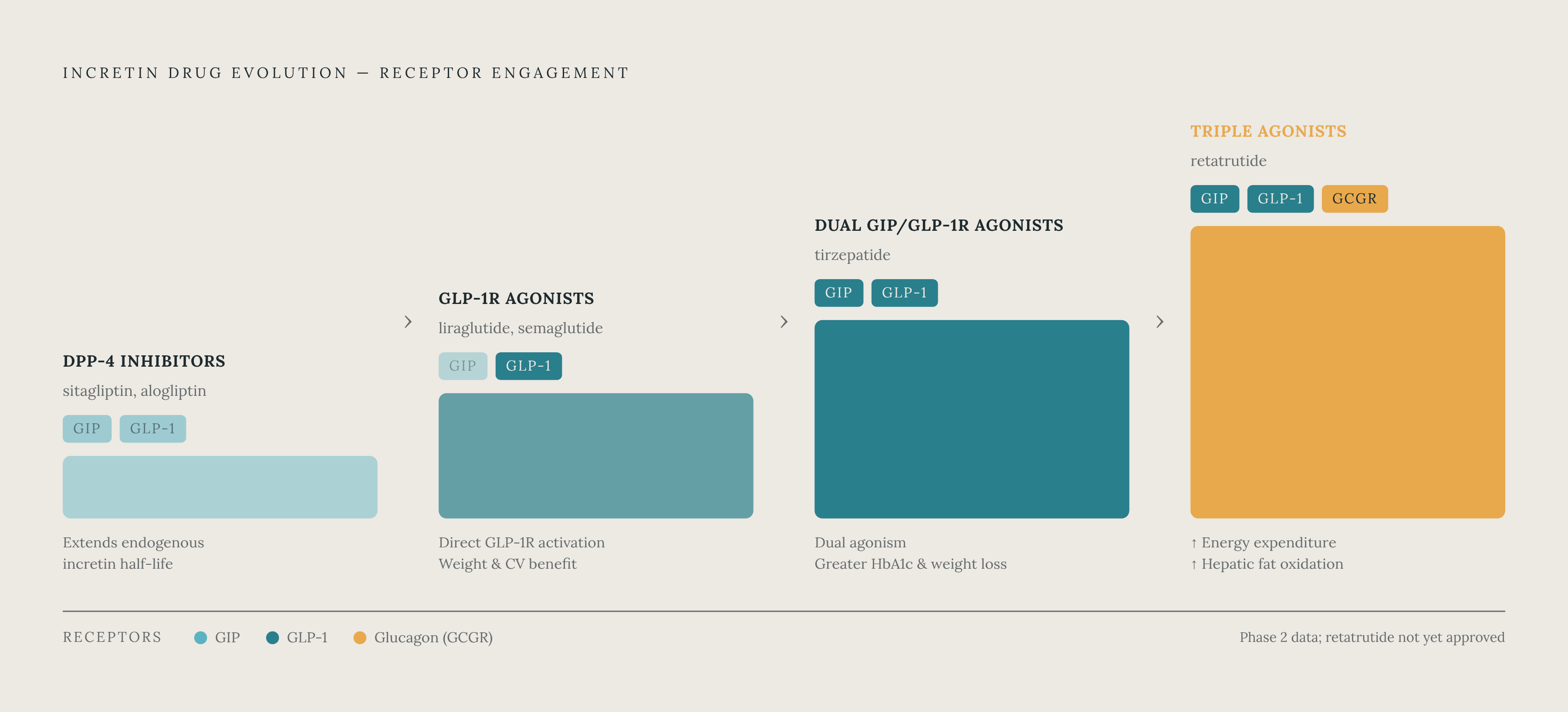
The therapeutic history of incretin drugs tracks the biology described above step by step, and each generation engages a broader slice of the system than the one before it. DPP-4 inhibitors came first, working by extending the half-life of endogenous GIP and GLP-1 through blocking the enzyme that rapidly inactivates them, producing modest glycemic improvement. That was a conservative opening move, one that validated incretin biology as a drug target without attempting to mimic the hormones directly. GLP-1R agonists, including liraglutide and semaglutide, moved past protecting endogenous peptide and into direct, potent receptor activation, delivering substantial weight loss and cardiometabolic benefit and establishing GLP-1R agonism as a central pillar of metabolic therapy. Triple agonists extend that logic one step further by adding the glucagon receptor: GLP-1R activation drives satiety and appetite suppression, GIPR activation boosts insulin secretion and nutrient partitioning, and glucagon receptor activation raises energy expenditure while promoting hepatic lipid oxidation. Retatrutide stands as the most clinically advanced triple agonist in the current pipeline: it has shown body weight reduction and hepatic fat reduction in Phase 2 trials, including a Phase 2a MASLD trial published in Nature Medicine in 2024. Other agents, including efinopegdutide, are pushing the multi-incretin approach further into MASLD and metabolic dysfunction-associated steatohepatitis, extending the hepatic-protection argument beyond weight loss alone (cotadutide's development for MASH, by contrast, was discontinued). Gupta and Shukla summarized the trajectory in 2026: incretin-based therapy has moved from DPP-4 inhibitors through advanced GLP-1 receptor agonists to next-generation dual and triple agonists, with retatrutide's weight and inflammatory-marker improvements marking the current frontier of the class. The amylin-pathway work covered later in this piece suggests that frontier is still moving.
The gastrointestinal side-effect problem and GIPR co-agonism as a partial solution
Gastrointestinal intolerance is the single factor most likely to limit how GLP-1R agonism gets used in practice, and evidence that GIPR co-agonism eases that intolerance suggests the multi-incretin approach can improve efficacy and tolerability at the same time. The nausea, diarrhea, vomiting, and constipation that accompany GLP-1R agonist treatment stem from mechanisms including delayed gastric emptying and central vagal activation, which are on-target consequences of how the receptor works physiologically rather than off-target toxicity to be engineered away. These effects are dose-limiting for a meaningful share of patients, and they drive discontinuation or dose reduction that undercuts the long-term adherence that durable metabolic benefit depends on. Researchers are actively investigating the central mechanisms behind GLP-1-induced GI events and how GIP might blunt them, and current evidence points to GIPR activation acting centrally to dampen the nausea signal that GLP-1R agonism generates, a mechanism that would help explain why dual agonists show a more favorable tolerability profile in clinical use. If GIPR co-agonism genuinely rescues some of the tolerability that GLP-1R agonism alone sacrifices, the shift toward dual agonists represents more than an efficacy upgrade. It recalibrates the entire risk-benefit equation, potentially opening the door to higher and more effective dosing for patients who cannot tolerate GLP-1 monotherapy.
The delivery problem that multi-incretin biology has not yet solved
Even the most sophisticated receptor pharmacology runs into a wall built by its delivery method. Injectable administration imposes cold-chain requirements, dose-escalation schedules, and needle burden, friction points that compound into substantial real-world discontinuation within the first year of therapy, regardless of how well the molecule itself performs. Peptide therapeutics also suffer from inherently low oral bioavailability: current oral GLP-1 formulations require food and water restrictions around dosing, and much of the gap between trial efficacy and real-world adherence traces directly back to those administration demands. Oral small-molecule GLP-1R agonists mark the first real structural break from peptide injection, removing cold-chain dependency and needle burden. But switching the route of administration does not automatically solve tolerability, a lesson illustrated by Pfizer's danuglipron, discontinued in April 2025 primarily over a liver safety signal, a single case of drug-induced liver injury identified in dose-optimization studies, following an earlier end to its twice-daily formulation in late 2023 after GI discontinuation rates exceeded half of patients across all doses. Delivery remains an open experimental frontier running in parallel with the receptor pharmacology itself, not a solved problem waiting for adoption.
GLP-1 receptors in the brain and the neurological indications that delivery innovation could unlock
GLP-1R and GIPR expression inside the brain, in the hypothalamus, hippocampus, cerebral cortex, and olfactory bulb, opens a set of neurological indications that injectable delivery is poorly suited to reach, because the blood-brain barrier restricts how much systemic peptide actually arrives at the CNS circuits that would need to be engaged. GLP-1 receptors sit abundantly in the hypothalamus and hippocampus, and GLP-1 has shown the capacity in preclinical work to induce neurite outgrowth, reduce neuroinflammation, lower oxidative stress, limit neuronal apoptosis, and curb pathological protein aggregation, while enhancing neuronal glucose metabolism and mitochondrial function. GIPR expression spans the olfactory bulb, cerebral cortex, hippocampus, and brainstem, a CNS footprint that has drawn less clinical attention than GLP-1R so far but one the expanding GIPR literature is starting to probe. A longitudinal cohort study by Cheng and colleagues in 2025, conducted in people with type 2 diabetes, found that GLP-1 receptor agonist use was associated with reduced dementia incidence relative to non-use, with an adjusted hazard ratio below 1.0 and a confidence interval that excludes the null. The most coherent way to reconcile that tension is mechanistic: subcutaneous delivery needs the drug to cross the blood-brain barrier, so it limits how much peptide reaches the brain regions the therapeutic hypothesis depends on, and the null result from EVOKE may reflect a failure of delivery as much as a failure of target. Future neurological trials would do well to prioritize brain-penetrant formulations, earlier intervention in disease course, and biomarker-guided patient selection, and the intranasal route, delivering peptide directly through trigeminal and olfactory pathways, is specifically positioned to address the penetration problem that may explain why EVOKE came up short. Addiction and substance use disorder present an adjacent indication where GLP-1R signaling in the CNS has already shown early signal, and the same argument about delivery applies there too: the circuits in question are central, the standard route of administration is peripheral, and testing the hypothesis properly may require getting the drug to the brain more directly than an injection under the skin ever could.
What the incretin field still requires
The field has moved, decisively, from thinking about a single hormone to thinking about a coordinated, multi-receptor, multi-organ system with implications well beyond glycemic control. The progression from DPP-4 inhibitors through GLP-1 agonists to dual and triple receptor agonists shows that expanding receptor engagement keeps producing greater metabolic benefit, and the pipeline is still widening. Amylin-pathway combinations are extending the multi-incretin logic even further, including AstraZeneca's AZD6234, a selective amylin receptor agonist now in Phase 2b through the APRICUS trial, completed in 2025, aimed at patients who cannot tolerate GLP-1-based drugs, with preclinical data suggesting fat-selective weight loss that preserves lean mass. The GIPR paradox, agonism and antagonism both producing benefit in different contexts, remains unsettled, and until researchers resolve it, the rationale for designing the next generation of GIPR-targeting agents will stay incomplete. Long-term safety data for dual and triple agonists are still limited, which argues for continued caution even as the efficacy evidence keeps accumulating. The incretin system, read through its full receptor distribution rather than through GLP-1 alone, functions as a coordinated physiological network built for postprandial energy optimization and organ protection together. Therapeutics that engage more of that network, through more of the routes the body already uses to run it, are where the underlying biology keeps pointing you.
Sources
- Editorial: Incretin-based therapies in the treatment of metabolic syndrome: expanding roles beyond weight management
- Role of endogenous incretin hormones, GLP-1 and GIP, in cardiovascular physiology
- GLP‐1 and GIP Beyond Glycaemia: Evolutionary Roles in Energy Optimisation and Organ Protection
- Evolution of incretin-based therapies: From GLP-1 monotherapy to dual and triple agonists: A new era in metabolic therapy - PMC
- Clinical Potential of GIP in Type 2 Diabetes and Obesity
- Editorial: The impact of GIP/GIPR on metabolic diseases: how the field is evolving
- The agony and the efficacy: central mechanisms of GLP-1 induced adverse events and their mitigation by GIP