GLP-1 Drug Market Landscape and Pipeline Analysis
Obesity drugs are multiplying, and delivery may decide who wins.
The GLP-1 drug class has grown into a pharmaceutical category of its own, pushed by overlapping epidemics in obesity and diabetes and by a steadily widening list of conditions the drugs appear able to treat. This piece looks at how big that market has become, how crowded the pipeline behind it now is, and why the next real contest among these drugs may come down to how they're delivered into the body rather than what they're made of.
The GLP-1 market's size and growth rate
Roots Analysis puts the market on a trajectory to reach $180 billion by 2035, from an already substantial base in 2026. Towards Healthcare, publishing in July 2026, arrives at a different number but points in the same direction, and the gap between forecasts says less about disagreement over the drugs' future than about how fast the ground is shifting under anyone trying to measure it. Becker's Hospital Review found that GLP-1s accounted for roughly one-seventh of all U.S. drug spending in 2025, making them the primary driver behind a U.S. prescription market that is projected to cross a historic threshold in 2026 for the first time. None of this growth comes from a single source. It comes from three forces compounding at once: the sheer scale of the obesity epidemic, label expansion that has carried these drugs into cardiovascular disease and sleep apnea, and the arrival of oral formulations reaching patients who never would have started an injectable. North America still holds the largest share of the current market, but Asia-Pacific is growing fastest, helped along by generic entry in India and China that opens up demand among patients who previously had no access at all. A market moving on three fronts simultaneously, crossing national spending thresholds and drawing in new regions at once, is not a market where a single molecule's efficacy data can hold a competitive edge for long. Scale like this invites competitors, and competitors change what "winning" in this category actually requires.
The pipeline's expansion from two molecules to a crowded, multi-target field
What started as a market defined by a small number of semaglutide-class molecules has turned into a field of dual- and triple-receptor combinations and genuinely new molecular formats, and that shift alone has made the competitive landscape far more crowded than it was even a few years ago. Becker's reports that sixteen additional GLP-1 drugs could reach the U.S. market between 2026 and 2029, and Roots Analysis finds that small-molecule formulations already hold the largest share of the market by molecule type, a reflection of how much easier they are to manufacture and formulate compared with biologics. That manufacturing advantage matters because it lowers the barrier for new entrants, and lower barriers mean more molecules competing for the same patients.
The chase for efficacy hasn't stopped at single-receptor drugs. Dual- and triple-agonist molecules that target GLP-1 alongside GIP and glucagon receptors are now in late-stage development, built on the logic that hitting more than one receptor pathway can produce more benefit per dose. AstraZeneca's oral small molecule elecoglipron moved into Phase III in June 2026 after Phase IIb results came back positive, a sign that the oral small-molecule approach is maturing alongside the injectable biologics it was built to compete with. On the biologic side, Labiotech's landscape report identifies cagrisema, a combination of GLP-1 and amylin, and retatrutide, a triple agonist, as the next step in combination peptide design.
Molecule count is only one axis of expansion. The other is what these drugs are approved to treat. In 2025 the FDA expanded the Rybelsus label to cover cardiovascular risk reduction, and according to Labiotech, companies are now exploring indications that extend into autoimmune conditions and hormone disorders. More molecules and more approved uses together mean no single drug or indication can anchor a company's competitive position for long. That instability is why delivery, not the molecule itself, is the next place companies will try to differentiate.
The biology behind why GLP-1s work across so many conditions
To understand why the pipeline keeps reaching into new disease categories, it helps to look at what GLP-1 actually does in the body. GLP-1 is an incretin hormone, released after eating, and when it activates its receptor it boosts glucose-dependent insulin secretion, suppresses glucagon, slows gastric emptying, and promotes the feeling of fullness. That combination of effects already explains the drug class's original use in diabetes, but it only scratches the surface of what the receptor pathway can do. The clinical evidence shows robust established efficacy in diabetes, with meaningful HbA1c reductions, in obesity, with weight loss of 7–24% depending on molecule and dose, and in cardiovascular protection, with meaningful reduction in major adverse cardiovascular events.
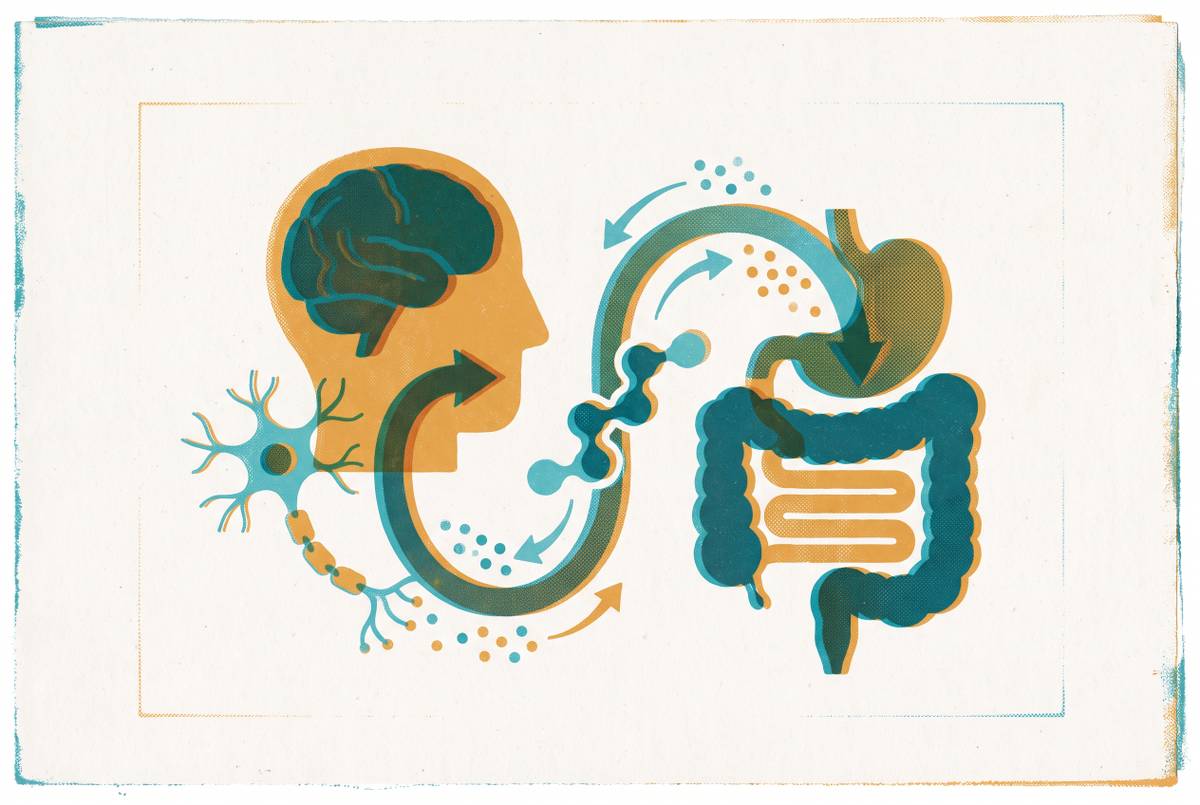
But the biology doesn't stop at the gut and the pancreas. Research reported by ScienceDaily shows GLP-1 receptors also sit in the brain, where they help regulate hunger signals, prompting eating when the body needs food and signaling fullness when it doesn't. That central nervous system action is a second, legitimate site of action built into the same receptor biology that already works in the periphery. One might ask why a hormone built to manage digestion and insulin would also touch the brain's reward and appetite circuits. GLP-1 receptors were never confined to the gut in the first place, so drugs built to activate them were always going to reach further than diabetes control. That dual site of action, peripheral and central, is what gives the pipeline its multi-indication ambition.
The pipeline beyond metabolic disease: addiction and dementia as test cases
The clearest evidence comes from addiction medicine, where results have been encouraging, and Alzheimer's research, where a high-profile trial just failed in a way that teaches its own lesson.
Start with addiction. A 2026 meta-analysis drawing on five observational cohort studies found that people taking GLP-1 receptor agonists had a meaningfully lower risk of being diagnosed with alcohol use disorder. Published pharmacology research shows GLP-1 receptor agonists influence dopamine transporter function and dopamine release in the brain's mesolimbic pathways, the same circuitry implicated in craving and reward, which explains the mechanism behind that finding. At Psych Congress 2026, BioSpace reported on brenipatide, a drug already in Phase 3 trials for alcohol use disorder. Altimmune's pemvidutide, tested in the Phase 2 RECLAIM study at a 2.4-mg dose, hit its primary endpoint with a statistically significant and clinically meaningful drop in heavy drinking days. A startup called Baseline Therapeutics launched in January 2026 around BT-001, a once-weekly GLP-1 analog now in a Phase 3 trial for alcohol use disorder that began in the first quarter of 2026, with trials in cocaine and methamphetamine use disorder planned to start later in the year. Separately, low-dose semaglutide has shown a significant reduction in some measures of alcohol consumption and craving among adults with alcohol use disorder. Taken together, this is a late-stage clinical program with multiple companies and multiple molecules converging on the same biological idea.
Dementia tells a more complicated story: two Phase 3 trials of semaglutide in early Alzheimer's disease, enrolling 3,808 participants between them, missed their primary endpoint in late 2025, as the drug did not significantly slow disease progression. What makes this result instructive rather than simply discouraging is what the trials did show. Patients on semaglutide saw improvement in Alzheimer's-associated biomarkers, showing the drug was doing something measurable at the biological level, but that biological activity never translated into slower clinical decline. That gap, between biomarker movement and clinical outcome, is the detail that matters. Earlier Phase 2 data from the ELAD study, using liraglutide, had been genuinely promising: patients on the drug lost less brain tissue in memory-relevant regions and showed slower decline in thinking skills compared with placebo. So the biology clearly does something in the brain. Whether enough drug is actually reaching the brain regions where it needs to act when given by injection points directly at delivery method as a possible explanation for why a drug that improves biomarkers can still fail to slow disease.
The adherence problem that the expanding pipeline has not solved
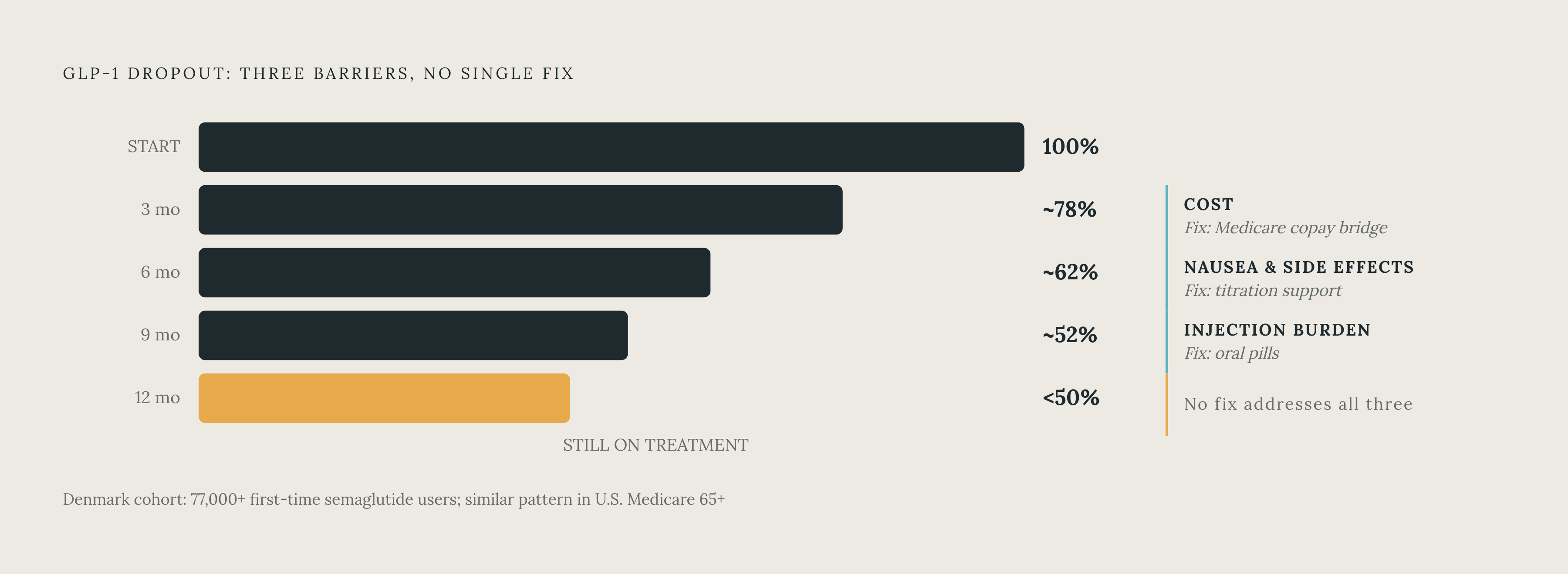
None of the pipeline expansion described above means much if patients can't stay on these drugs long enough to benefit from them. Across the GLP-1 class, most patients who start treatment stop within a year, and the leading reasons, nausea, the burden of injecting, and cost, all trace back to how the drugs are delivered rather than to anything about their pharmacology. A population-based study of more than 77,000 first-time semaglutide users in Denmark found that over half had stopped taking the drug after one year, with meaningful fractions dropping off within the first three, six, and nine months. Discontinuation wasn't evenly distributed. Younger users between 18 and 29 were disproportionately likely to quit, and so were patients with a history of taking gastrointestinal medications, patterns that point toward tolerability problems rather than patients losing confidence that the drug works.
The same pattern appears in an entirely different population. Becker's reports that a majority of Medicare patients over 65 stopped taking semaglutide within a year, citing cost, side effects, and muscle mass loss as contributing factors. Across the injectable class broadly, nausea affects roughly one in five patients taking either liraglutide or semaglutide, and diarrhea and vomiting affect meaningful shares as well. A large sample of FDA adverse event reports found that GLP-1s carry a substantially higher share of administration-related reactions than insulin does. A Medicare bridge program launched in July 2026 and running through December 2027 now offers GLP-1s at a reduced monthly copay, which addresses the cost barrier directly.
The oral pills that have recently arrived on the market remove the needle, but gastrointestinal side effects remain a documented class effect regardless of route, and oral small molecules bring their own formulation challenges around how much of the drug the body actually absorbs. The dropout problem is at least three separate barriers, cost, nausea, and injection burden, and so far each proposed solution has addressed one without touching the other two.
Why the injectable and oral routes cannot fully solve what they created
Both the injectable and oral routes deliver the drug through the rest of the body before any of it reaches the brain, which produces peripheral side effects and restricts how much of it reaches central targets in ways that are route-dependent, not molecule-dependent. Subcutaneous injection is invasive, uncomfortable for many patients to administer, and produces systemic side effects well before the drug reaches any central nervous system target it's meant to hit. Even then, it still has to cross the blood-brain barrier to act on the brain at all. That barrier is not a minor hurdle. It excludes roughly 98% of small molecules and nearly all large biopharmaceuticals from entering the central nervous system.
That figure deserves a moment of attention, because it reframes much of what came before it. If a drug has to pass through the gut, the bloodstream, and then a barrier that blocks 98% of small molecules before it can act on the brain, then the Alzheimer's trial that showed biomarker improvement without clinical benefit looks less like a failure of the molecule and more like a question about whether enough semaglutide was reaching the right place in the brain at all. The same logic applies to the addiction trials showing real promise.
Oral formulations solve the needle problem but not the route problem. The drug still has to survive digestion, enter systemic circulation, and then clear the same blood-brain barrier that injectables face, so the central nervous system bioavailability question doesn't go away just because the needle does. What both routes share is a basic design constraint: they were built to treat metabolic disease by acting on receptors in the gut and periphery, and the central nervous system effects, whether in appetite regulation, addiction, or neurodegeneration, were discovered downstream of that original design rather than built into it from the start. A market this large, growing this fast, with a pipeline this broad, is running up against a delivery architecture that predates most of what it's now being asked to do. The molecules keep multiplying and the indications keep expanding, but the question of how to get enough of the drug to the right place in the brain, reliably and without the side effect burden that drives a majority of patients to quit within a year, remains open. That is the terrain where the next phase of competition in this category will likely be decided.