GLP-1 Agonist Comparison for Weight Loss Outcomes
Tirzepatide and semaglutide lead, but real-world adherence determines actual weight loss.

GLP-1 receptor agonists share a common starting point but no longer share a common mechanism, and that split is the reason a single drug class now produces such different weight-loss results from one agent to the next. GLP-1 itself is a hormone the gut releases after eating. It slows appetite and triggers insulin release when blood sugar climbs, which is the basic biology behind both the metabolic and the weight-loss effects the class is known for. Native GLP-1 breaks down within minutes in the body, so every approved drug in this class is a modified version, built to resist that breakdown and stay active far longer than the hormone does on its own.
Where that modified hormone acts matters as much as how long it lasts. GLP-1 receptors sit in the pancreas, in the gut, and in the brain, particularly in the regions that govern appetite and reward. Most agents in the class bind only the GLP-1 receptor. Tirzepatide is built differently: it activates both the GLP-1 receptor and the GIP receptor, and that dual action is what produces its stronger glucose control and stronger appetite suppression relative to single-target drugs, a gap the next section puts numbers to. GLP-1 signaling also touches areas well outside metabolism, with evidence of cardioprotective, neuroprotective, and anti-inflammatory effects, and a role in learning, memory, and reward behavior. That broader reach matters later in this piece, once the discussion turns to the brain as the real target organ for weight control and to what delivering a drug there, rather than through the bloodstream, might change.
Clinical evidence on which agents produce the most weight loss
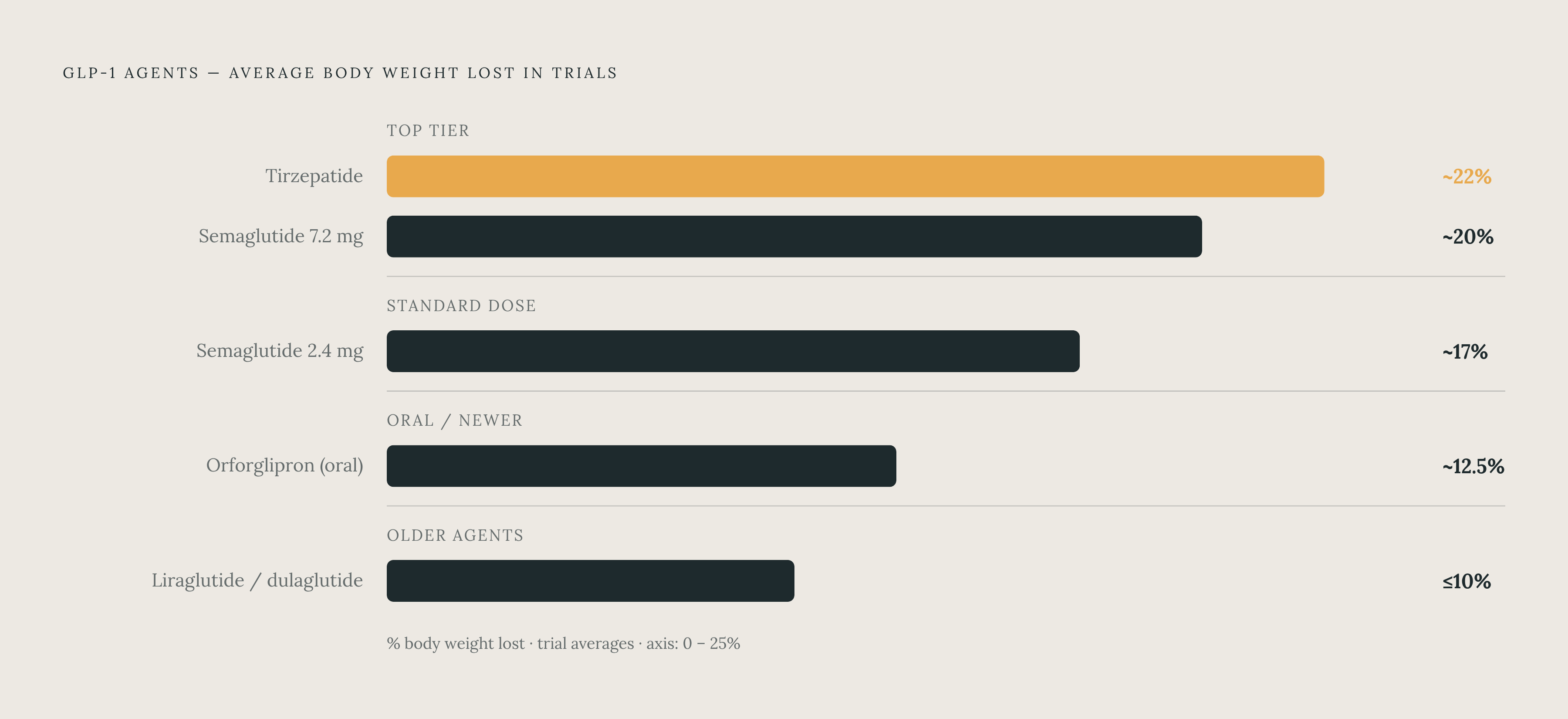
Lay the clinical trial results for this class side by side and a clear hierarchy appears, with dual-mechanism and high-dose agents well ahead of older single-target drugs and an oral entrant marking out a separate, injection-free category.
Tirzepatide sits at the top of that hierarchy. A 2026 systematic review and network meta-analysis ranked it highest in efficacy among all agents evaluated, with a SUCRA score of 91.2%, and semaglutide close behind it. Patients on tirzepatide in major trials lost between roughly a fifth and a quarter of their body weight, a result no single-target agent in the review matched. High-dose semaglutide belongs in that same top tier: the STEP UP trial found average weight loss of about one-fifth of body weight at the 7.2 mg dose, compared with roughly one-sixth at the long-established 2.4 mg dose, showing how much dose alone can move the outcome within a single drug.
Standard-dose semaglutide, at the approved 2.4 mg weekly dose, produces average weight loss around one-sixth of body weight, a result that has held up across a large base of trials and marks the second tier of the class. Older GLP-1 monotherapies, including liraglutide and dulaglutide, fall well below that: average weight loss for these agents runs at roughly one-tenth of body weight or less. That's still a clinically meaningful result for many patients, but the distance between this tier and the top one is wide.
Orforglipron adds a different kind of data point. As a small-molecule oral agent, it produced roughly one-eighth of body weight lost at its highest dose over 72 weeks in clinical trials, a number lower than the injectable top-tier agents but important for a separate reason: it sets the bar that any needle-free delivery approach now has to clear to be taken seriously as an alternative.
A March 2026 Johns Hopkins meta-analysis of 64 clinical trials found GLP-1 receptor agonists similarly effective across patients of different ages, races, and starting weights, with women showing somewhat greater benefit than men, demonstrating how little demographic variation shapes these tiers. In other words, which tier a patient lands in has far more to do with the agent and dose prescribed than with who the patient is. And the ceiling on all of this keeps rising: early trials of emerging multiagonists, including amycretin and retatrutide, show placebo-subtracted weight reductions that already push past today's top-tier incumbents.
Efficacy rankings and real-world weight-loss outcomes
All of those numbers describe what happens inside a clinical trial, where dosing is monitored, follow-up is structured, and patients tend to stay enrolled. Real-world use looks nothing like that. Cohort studies tracking GLP-1 use outside trial settings find that most people who start on these drugs stop within a year, and a large share stop within six months, long before they could reach the weight-loss outcomes the trials describe.
Three forces drive that drop-off, and they tend to compound each other rather than act alone: cost, adverse effects, and gaps in insurance coverage. A patient who can't afford a drug long-term is also more likely to abandon it the first time side effects become hard to manage, since there's no financial cushion to ride out a rough few weeks. Gastrointestinal effects, nausea, vomiting, and gastroparesis among them, carry a substantial side-effect burden and appear repeatedly in the discontinuation literature as the leading cause patients give for stopping treatment, occurring at rates substantially higher than in placebo groups during randomized trials, with the exact rate varying by drug and by which GI event is being measured.
The burden doesn't land evenly. Younger patients and patients in lower-income areas discontinue at higher rates than the overall population, which points to access and support, not just biology, as part of the problem. One counterexample makes that point sharply: a structured specialty pharmacy support program achieved a far lower one-year discontinuation rate than the population average, suggesting that a meaningful share of the adherence gap comes from support infrastructure. Few patients ever get that level of support, so the finding says more about what's possible than about what's typical.
What falls out of all this is a fairly stark recalculation of what "effective" means in practice. A patient who achieves tirzepatide-level results on paper but stops at month five keeps far less of that benefit than a patient who stays on an older, less potent agent for years. Tolerability and adherence, not peak trial efficacy, decide how much weight loss a patient actually keeps.
Where GI side effects come from biologically
The nausea driving most of that discontinuation is not a fixed cost of taking a GLP-1 drug. It traces back to a specific design feature: these drugs are built to act on the brain, but they're delivered through the body.
Subcutaneous GLP-1 drugs enter systemic circulation after injection and travel everywhere blood goes. They reach the brain's appetite centers by crossing into circumventricular organs, specialized brain structures whose capillaries are more permeable than the rest of the blood-brain barrier, which lets the drug slip through without a dedicated transport system. But to get there, the drug also activates GLP-1 receptors all through the gut, and that peripheral activation is what produces the gastroparesis, nausea, and vomiting patients report. The brain is where the drug needs to act to suppress appetite. The gut is simply where it happens to pass through on the way, and that detour is what makes patients sick.
GLP-1 receptors are distributed not only in the pancreas and digestive system but also in brain regions governing appetite and reward, a distribution that underscores why the route a drug takes to reach those receptors matters as much as the receptors themselves. Centrally targeted approaches can engage appetite suppression directly, and that distinction becomes important when weighing whether alternative platforms, including intranasal nanoparticle technologies under development at companies like Lionbio, can reproduce the central effects of injected GLP-1 drugs without routing the drug through the gut first.
Nasal delivery offers a way around that detour grounded in existing anatomy. The olfactory and trigeminal nerves run a direct line from the nasal lining to the brain, outside systemic circulation. A drug that reaches the brain this way could, in principle, achieve a higher concentration where it's needed while exposing the rest of the body, including the gut, to far less of it, making delivery route a problem to engineer around so patients stay on a drug long enough to get its benefit.
The nose-to-brain delivery pathway in preclinical science
The nose-to-brain route, often shortened to N2B, carries substances into the brain along the olfactory and trigeminal nerves. The pathway has been used preclinically to move peptides, proteins, stem cells, and nucleotides, making it a platform for many drug types beyond small molecules.
Formulation science around this route has moved fast. Cell permeation enhancers, mucoadhesive systems, and nanocarriers built into nasal formulations have shown encouraging results across a range of preclinical studies. One concrete data point comes from MetP Pharma, which reported in a 2025 rat study that intranasal semaglutide achieved brain-to-plasma ratios consistently above 1, with the drug concentrating in the brain in excess of what reached the bloodstream under their formulation conditions. The academic side of the field is active too: a thermoresponsive nanocarrier called PNPHO, built specifically for intranasal semaglutide delivery, was published in the International Journal of Pharmaceutics in 2026, a sign that specific technical solutions, not just general interest, are coming out of university labs.
None of that settles the question of whether this works in people, and the field's own data makes that clear. A 2025 PET imaging study by Winterdahl and colleagues, run in live human volunteers, found that brain uptake after intranasal oxytocin administration was low and variable. The sharp brain-to-plasma ratios seen in rodents are unlikely to appear in humans without real improvements to the formulations being tested. That gap between animal and human results is the field's most openly discussed limitation, and the honest answer is that strong preclinical data doesn't guarantee a drug will work the same way in a person. Closing that gap, not restating the preclinical promise, is what the field now needs, and it's the exact problem nanoparticle engineering has been built to address.
What nanoparticle engineering contributes to intranasal peptide delivery
Nanoparticle engineering earns its place in this story because it targets the specific points where nasal peptide delivery tends to fail, not because nanoparticles sound advanced. Three failure modes stand between the preclinical promise described above and anything usable in a clinic: the peptide degrades too fast, it struggles to cross the nasal mucosa, and too little of it reaches the brain once it's inside.
Native GLP-1 already breaks down quickly in the body. Every approved injectable in this class is engineered for a longer half-life. The nasal cavity adds its own layer of difficulty on top of that: enzymes and mucus clearance there degrade peptides even faster than systemic circulation does, and nanocarriers can shield the drug from that environment long enough for it to cross into brain tissue. Different nanoparticle types tackle different parts of the problem. Lipid nanoparticles, polymeric carriers such as PLGA, inorganic nanoparticles, and biomimetic scaffolds each handle a different piece of the delivery chain. PLGA nanoparticles in particular have already been used in GLP-1 formulations to stretch a single dose's release out over weeks.
Some of the more interesting work targets the receptor interaction itself. Generation 4 PAMAM dendrimers, decorated with multiple copies of a GLP-1 mimetic on a single particle, show a 15-fold increase in receptor avidity compared with the monomeric peptide alone, published nanoparticle research shows. That multivalent approach is a way of compensating for a drug that may arrive in the brain at lower absolute concentrations than an injection would deliver systemically: hit the receptor harder per molecule, and a lower total dose can still produce a strong effect. A separate strategy out of MIT takes a different route entirely, attaching GLP-1 receptor agonists to the body's own circulating antibodies. The system uses a binder region that attaches to the antibody, a payload region carrying the GLP-1 agonist, and a reactive region that forms a covalent bond between the two, effectively turning the body's own IgG molecules into a longer-acting carrier for the drug.
What stands between these laboratory results and a product on a shelf is less about the chemistry and more about manufacturing it the same way every time. Particle size, how densely the targeting ligand is packed onto each particle, and the rate at which the drug releases all have to stay consistent at production scale, not just in a research batch. That reproducibility question, backed by pharmacokinetic and safety data at scale, is the actual bottleneck between a clever particle design and a drug that regulators and patients can rely on.
Lionbio's nose-to-brain platform in the intranasal GLP-1 field
Among the companies working on this problem, Lionbio stands out for the depth of the science behind its platform rather than for being first to announce a nasal spray. Lionbio is a Columbia University spinout building an intranasal GLP-1 therapeutic delivered through a precision nasal spray, designed to move GLP-1 peptides along the intranasal route described earlier in this piece, with the same nose-to-brain mechanism opening a path toward future CNS indications beyond weight loss.
What separates a platform like this from a one-off formulation experiment is the foundation under it. Lionbio's approach rests on more than 30 years of patented nanoparticle intellectual property, built by a team with an extensive patent portfolio and a substantial body of academic citations behind it. That's a meaningful detail, because the gap described in earlier sections, between a promising rat study and a drug that actually works in a human nose, tends to close only with sustained, specific engineering work, not a single clever formulation.
The nausea-driven discontinuation described earlier in this piece reflects something deeper than an unfortunate side effect: the injection-based delivery model itself may be capping how much benefit this drug class can realistically deliver outside a trial setting. Emerging delivery approaches, intranasal platforms among them, are trying to answer a specific question raised throughout this piece: can a different route hold onto the efficacy of injectable GLP-1 drugs while cutting gastrointestinal side effects enough that more patients stay on treatment. Lionbio's stated design goal is to match injectable efficacy while meaningfully reducing both nausea and the burden of needle-based dosing, which are precisely the two factors identified earlier as the leading drivers of discontinuation.
Other paths to that same goal exist and deserve mention on their own terms. A patient weighing GLP-1 options today might go through an insurer's standard injectable formulary, try an at-home titration kit shipped by a telehealth provider, or wait for an oral small-molecule option like orforglipron to become more widely available. Each of those represents a different trade-off between cost, convenience, and the tolerability problems described throughout this piece. Intranasal delivery, grounded in the olfactory and trigeminal pathway and the nanoparticle engineering built to make that pathway usable for a peptide drug, represents a fourth path, aimed squarely at adherence rather than at adding another percentage point to a trial's weight-loss curve. Whether it closes the gap between rat data and human results is still an open question, but it's the question the entire intranasal GLP-1 field, Lionbio included, is now built around answering.