Nanoparticle Surface Functionalization for CNS Targeting
How coatings and ligands let peptides reach the brain via the nose.
Nanoparticle nose-to-brain delivery for CNS peptide indications uses olfactory and trigeminal pathways to bypass the blood-brain barrier. Surface functionalization is the decisive engineering layer because it governs mucus interactions, epithelial uptake, and targeting. Preclinical findings support this approach, but it is still unclear whether it can reliably deliver therapeutic concentrations in humans.
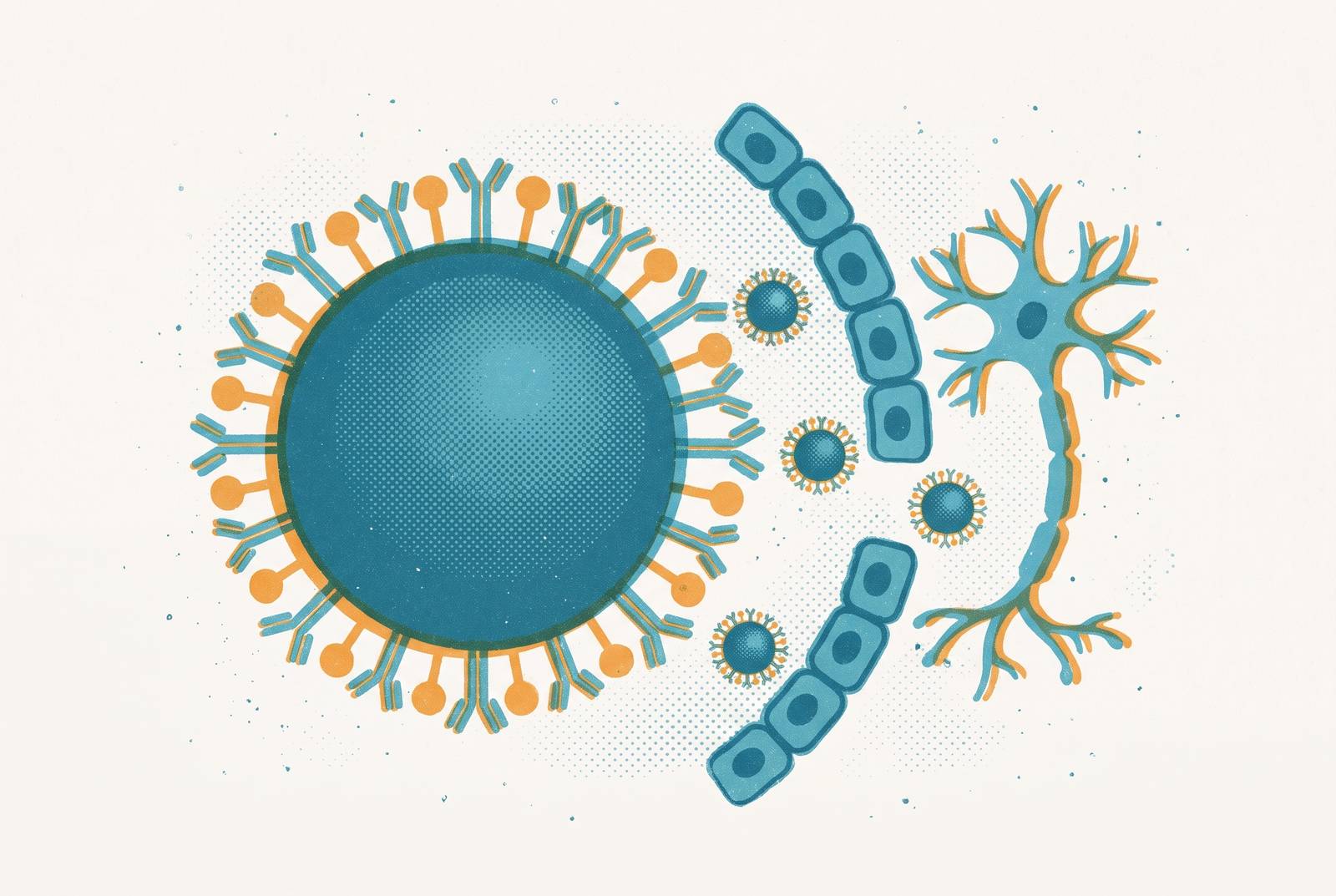
Surface functionalization determines whether a peptide-loaded nanoparticle can get through the nasal mucosa and onto the olfactory or trigeminal route at all. Positive charge, as with chitosan, binds mucin and lengthens retention, and chitosan can also open epithelial tight junctions. PEG coatings help particles move through mucus instead of sticking to it. Ligands such as transferrin and lactoferrin drive receptor-mediated uptake and axonal transport, while cell-penetrating peptides like TAT cross lipid bilayers independent of receptor expression. In Meng et al.'s Huperzine A work, lactoferrin-conjugated TMC-PLGA particles gave higher brain fluorescence than either control, though the evidence is still preclinical.
Why the brain remains so hard to treat with drugs
About 98% of possible CNS medicines never reach effective concentrations in the brain, mainly because of the blood-brain barrier. The barrier is more than a physical seal. Tight junctions restrict passage between cells, enzymes degrade susceptible molecules, and active efflux transporters remove drugs that might otherwise enter. A candidate can therefore have useful pharmacological activity yet fail before it reaches its target.
Systemic delivery adds another set of constraints. First-pass metabolism can leave less drug available, while toxicity can limit the dose before concentrations in the brain are high enough. These limits help explain why neurological disorders are still hard to treat after decades of spending on drug development. As populations age and the neurological burden grows, the central question is not simply which molecules can affect disease biology. It asks how enough intact drug can reach the brain tissue that needs it without exposing the rest of the body to unacceptable amounts.
How can nasal delivery get large-molecule peptides to the brain?
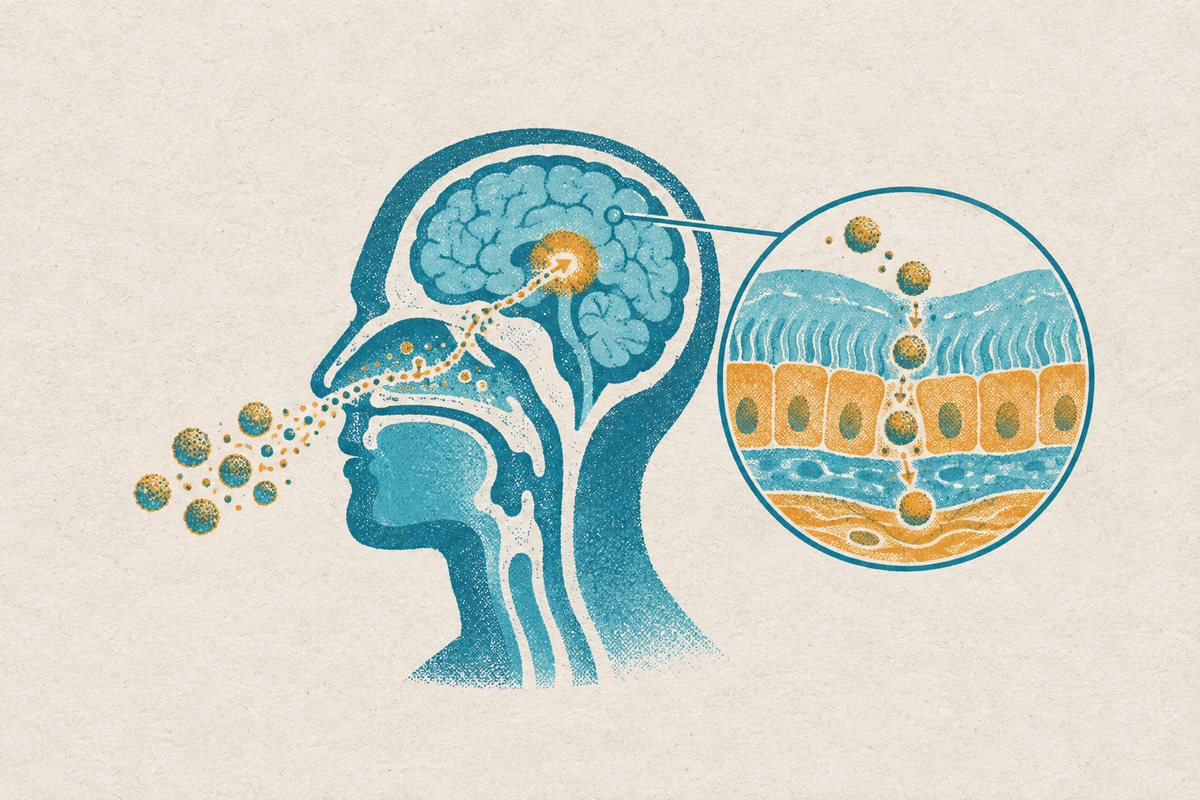
The nasal cavity offers an anatomically distinct answer. Olfactory and trigeminal nerve pathways connect it to the brain, providing routes that can bypass the blood-brain barrier. Drugs or carriers crossing the olfactory epithelium can travel along olfactory nerve axons through the cribriform plate to the olfactory bulb and then deeper structures. The trigeminal pathway provides a parallel connection to the brainstem and higher regions, broadening the potential territory of delivery.
Transport involves epithelial uptake and movement along neural pathways alongside passive diffusion. Direct nose-to-brain transport may also reduce systemic exposure relative to injectable delivery, but that potential advantage depends on how the formulation distributes its payload. There are strong reasons why this mechanism could work, but evidence for its use in specific treatments is still mostly preclinical.
Why the nasal cavity defeats bare molecules before they reach the olfactory epithelium
Before a peptide reaches either neural pathway, it encounters the nasal mucosa. Mucus is a viscoelastic gel that traps molecules and particles, while mucociliary clearance sweeps trapped material toward the throat. The available absorption window is therefore limited. Nasal peptidases further narrow it by degrading peptide and protein drugs in the mucus and at the epithelial surface.
Encapsulation can shield the payload from enzymatic attack. That protection extends the time in which an intact peptide might reach cells capable of taking it up. But survival and transport are different requirements. A protected particle immobilized in mucus may still be cleared before its payload becomes useful. Encapsulation creates the opportunity for delivery, but surface chemistry decides whether the carrier can use it.
How does surface functionalization of nanoparticles affect nose-to-brain delivery of peptide drugs?
Positively charged surfaces interact with negatively charged mucin fibers, which keeps particles on the mucosa for longer. Chitosan supplies this charge through its protonated amine groups and can also open epithelial tight junctions, creating a window for paracellular transport. Charge alone, however, does not identify a neuronal target. Its contribution is to alter retention and access so that subsequent uptake mechanisms have time to operate.
Retention can also become a transport liability. Mucoadhesive coatings such as chitosan and carbopol favor attachment, whereas PEG creates a hydrophilic shell that helps particles move through mucus. The choice depends on the bottleneck. Adhesion may help when absorption is slow, but penetration matters more when mucus traps particles or is quickly cleared. Maximizing either property without considering the other can work against delivery.
Transferrin and lactoferrin bind receptors on olfactory epithelial cells and neurons, promoting receptor-mediated endocytosis and axonal transport. Cell-penetrating peptides, including TAT, facilitate passage across lipid bilayers through a mechanism independent of receptor expression. A design might combine a cationic chitosan base, a PEG outer coating, and a lactoferrin ligand, although their combined performance still requires testing.
The 2024 Chinese patent CN118021764A describes one example of how surface modifications can be combined. It specifies chitosan nanoparticles functionalized with TAT polypeptide and lactoferrin to deliver the CCR5 peptide antagonist DAPTA for cognitive dysfunction, defining an architecture that still requires clinical validation. Its significance is that protection, cell entry, and receptor engagement are addressed within the same system rather than assigned to the encapsulating material alone.
What surface-functionalized nanocarriers have actually achieved in preclinical CNS models
Meng et al.’s 2018 study compared how different surface functions work. Its Huperzine A system combined PLGA with lactoferrin-conjugated trimethyl chitosan, or TMC, to address poor brain selectivity and gastrointestinal side effects. Mucin adsorption exceeded that of plain PLGA nanoparticles but was not significantly higher than that of TMC nanoparticles. The targeting results separated the systems more clearly. Brain fluorescence and targeting to memory-related areas were higher than with either control, which shows that mucus binding alone cannot explain how much accumulates in the brain.
Other preclinical applications extend the argument beyond neurodegeneration. Surface-modified polymeric nanoparticles delivering antipsychotics and neuropeptides, including oxytocin and vasopressin, have shown efficacy signals and reduced systemic exposure in schizophrenia models. Large peptides that enzymes can break down need protection against degradation and a way to reach cells, so better uptake must be assessed alongside how much drug arrives intact.
Neuro-oncology introduces a harder spatial targeting problem. For glioblastoma multiforme, the Stupp protocol of surgical resection, radiotherapy, and temozolomide leaves median overall survival at 14–18 months. Intranasal chitosan formulations seek to improve access, while surfaces responsive to local pH, redox state, or glutathione offer further control within the tumor environment. But how well they penetrate deep tumor structures and infiltrative margins still needs to be tested systematically. Brain accumulation is not equivalent to reaching every disease-relevant compartment, and none of these preclinical signals establishes human efficacy or safety.
GLP-1 peptides as a case study in why delivery architecture determines therapeutic success
GLP-1 receptor agonists expose the consequences of distribution particularly clearly. Their receptors occur in the brain as well as the pancreas, intestine, lung, stomach, kidney, and heart. Systemic exposure therefore engages many tissues at once. That broad activity supports therapeutic effects but also complicates brain-directed treatment, because a neurological dose must be considered against peripheral receptor activation.
Nausea was reported in 33% of patients in published GLP-1 receptor agonist side-effect data. Nausea, diarrhea, and vomiting are associated with the peak concentrations created by subcutaneous injection, making exposure profiles a relevant part of tolerability. The injectable route and its side effects are also linked to suboptimal adherence. Lower systemic exposure for a brain-targeted intranasal dose could reduce peripheral activation, although that benefit remains to be demonstrated for the proposed formulations.
EVOKE and EVOKE+ tested a GLP-1 receptor agonist in early symptomatic Alzheimer’s disease but did not meet their primary endpoints. ELAD also investigated the class in Alzheimer’s, while brenipatide is in human clinical trials for craving and substance use disorder. Nanoparticle formulation is not new to these payloads. PLGA-derived polymeric nanoparticles have been used for long-acting GLP-1 peptide formulations, but adapting that foundation for nasal brain targeting requires a different surface and distribution strategy.
Why GLP-1s have underdelivered on neurological endpoints, and what that reveals about brain penetration
A meta-analysis of randomized controlled trials found no improvement in memory and cognition over placebo in Alzheimer’s patients, with a standardized mean difference of −0.01 and low-certainty evidence. A separate 2025 study found the same lack of improvement in people with established disease. These findings document underperformance of the tested treatments. They do not establish that a different route would succeed.
What remains unresolved is whether current formulations achieve sufficient brain penetration and target engagement in humans. A negative clinical endpoint does not by itself distinguish inadequate delivery from inadequate therapeutic biology. BBB restriction makes insufficient exposure a coherent explanation, but not the only possible explanation and not a demonstrated cause of failure.
Surface-functionalized intranasal delivery makes that exposure hypothesis testable. Preclinical comparisons of ligand-bearing and unfunctionalized nanoparticles show that surface engineering can change brain accumulation. Those findings justify investigating whether a similar strategy can improve CNS exposure for GLP-1 peptides. They do not answer the clinical question in advance. The proposed advantage is a way to test delivery more directly while retaining unsuccessful Alzheimer’s trials as relevant evidence.
The translational gap between preclinical promise and clinical reality
Human olfactory epithelium occupies only a small fraction of nasal surface area, compared with the majority in rodents, so favorable rodent absorption geometry does not transfer directly. Limited nasal dose capacity further constrains formulation design. Device-dependent deposition can then change how much material reaches the intended site, making delivery performance a property of the formulation and its administration together.
Adsorbed proteins can form a protein corona that masks ligands and weakens targeting. Chronic dosing also raises unresolved questions about long-term safety and immunogenicity, particularly for chitosan systems. These questions are especially relevant to sustained neurological treatment. A short preclinical experiment cannot settle them.
Promising systems are difficult to compare or characterize for regulatory review because of batch variability, nonstandard assessment protocols, and the lack of harmonized pharmacokinetic and pharmacodynamic frameworks. Nasal epithelium and blood-brain barrier organ-on-chip models are being developed to narrow the human–rodent gap, but remain under validation. Overcoming these limitations requires engineering and methodological discipline beyond better results in animals alone.
What distinguishes surface functionalization platforms that can bridge the translational gap
A translatable platform must make its surface reproducible. Charge density, coating behavior, and ligand presentation need to function as controlled design variables rather than properties of a successful laboratory batch. Characterized manufacturing processes offer a stronger foundation than one-off formulations because it is possible to check how consistent they are from one production run to the next. Patent protection can support that foundation, but cannot substitute for performance evidence.
A platform able to swap ligands, adjust charge, or layer coatings can address the distinct transport requirements of neurological peptides and other CNS drugs. That flexibility requires documented performance across payloads and indications. For GLP-1 peptides, PLGA-derived cores offer an existing manufacturing and regulatory history onto which surface functions can be added. The nasal formulation still needs its own evidence.
Physiologically relevant testing, including ex vivo human tissue, can examine whether mucus transport and epithelial uptake persist outside favorable rodent anatomy. Comprehensive chronic toxicity evaluation addresses sustained dosing, while consistent pharmacokinetic and pharmacodynamic methods connect exposure to effect. Regulatory alignment belongs within that development process.
A foundation of thirty-plus years of characterized nanoparticle IP can provide prior characterization and manufacturing knowledge against which new surface designs are evaluated. Its value lies in the evidence behind it. For CNS peptide delivery, the deciding question is whether that foundation supports reproducible transport, measurable brain exposure, and tolerable repeated administration in relevant conditions. Surface functionalization earns its place as the central design problem when those properties can be engineered and demonstrated together.
Sources
- Chitosan-Based Nanoparticles for Nose-to-Brain Drug Delivery: A Real Path toward Effective CNS Therapy? - PMC
- Targeting the brain through the nose: Advances in polymeric nanoparticle delivery for schizophrenia - ScienceDirect
- Chitosan-Based Nanoparticles for Nose-to-Brain Drug Delivery: A Real Path toward Effective CNS Therapy?
- Surface-Modified Nanocarriers for Nose-to-Brain Delivery: From Bioadhesion to Targeting
- Intranasal Chitosan Nano-Formulations: A Novel Frontier in Brain Cancer Therapy
- A comprehensive insight of innovations and recent advancements in nanocarriers for nose-to-brain drug targeting
- Intranasal drug delivery: Pathways, challenges, and advancements in CNS targeting - ScienceDirect