Engineering Nanoparticles to Solve the Three Mucosal Barriers That Block Intranasal Peptide Transit to the Brain
Nanocarrier design must defeat mucus, tight junctions, and enzymes to deliver peptides to the brain.
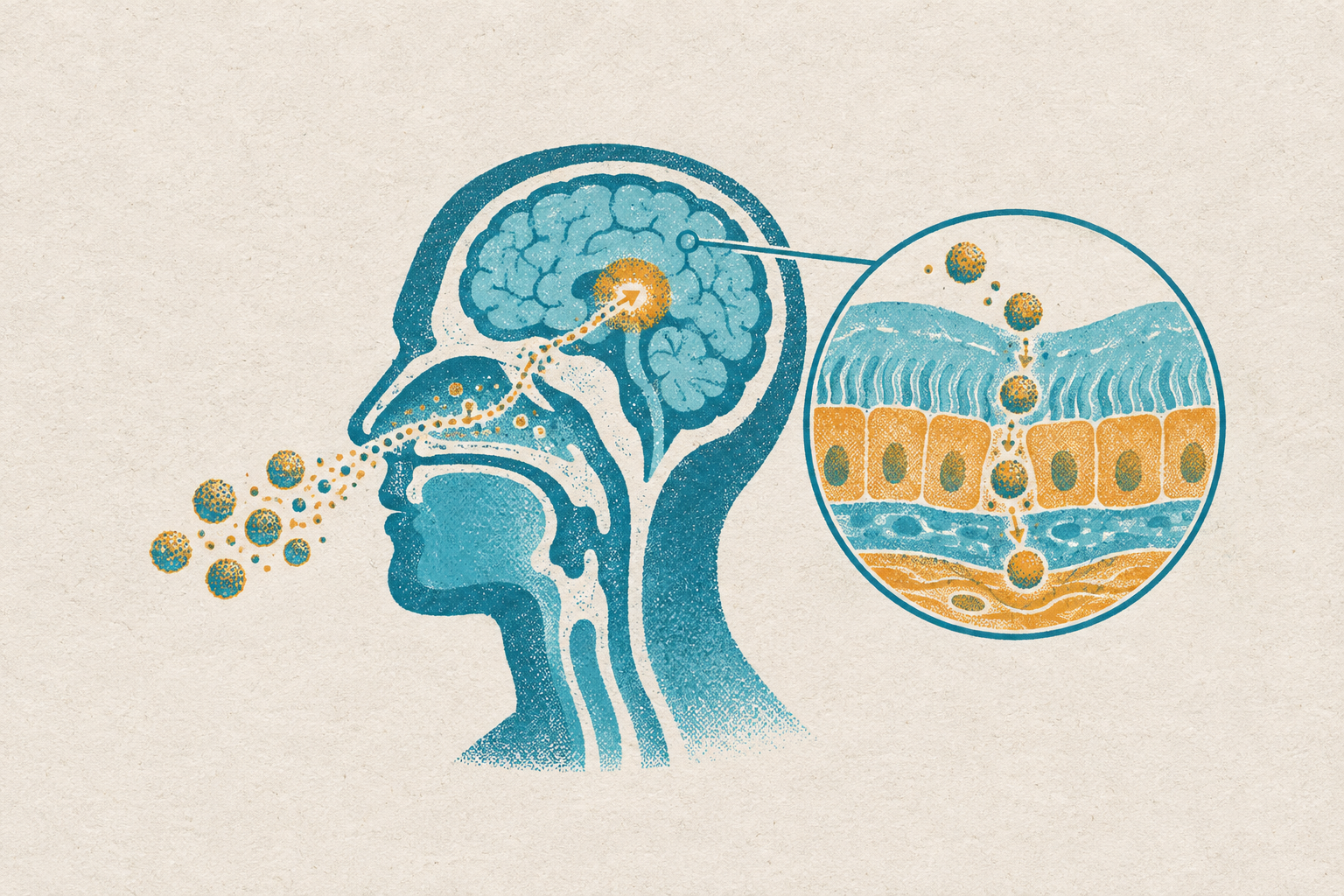
Nanoparticle nose-to-brain delivery for CNS peptide indications aims to bypass the blood-brain barrier through nasal nerve pathways, but it must still overcome mucus, epithelial tight junctions, and enzymatic degradation. Each obstacle requires a different engineering response. Viable delivery therefore depends on rational nanocarrier design that integrates particle geometry, surface chemistry, and encapsulation.
Why the nose-to-brain route exists and what it was designed to circumvent
The blood-brain barrier blocks more than 98% of small molecules and virtually all large molecules from entering the brain through the bloodstream. Peptides are particularly disadvantaged because they are often large and hydrophilic, although some can cross through lipid diffusion, saturable transport, or transcytosis. The obstacle is structural.
Intranasal delivery offers a different anatomical route. The nasal cavity contains vestibular, respiratory, and olfactory regions, with the olfactory region providing the most permeable epithelial interface with direct neural projections into the CNS. Some of the drug given may still enter systemic circulation. However, the olfactory and trigeminal nerve connections offer a path from the nasal cavity to the brain that can bypass both systemic circulation and the BBB.
Why bypassing the BBB is not the same as reaching the brain
Less than one percent of the dose given may reach the brain. Bypassing the BBB does not remove the barriers to transport. The drug then faces a different set of barriers, each of which can keep it from reaching the brain.
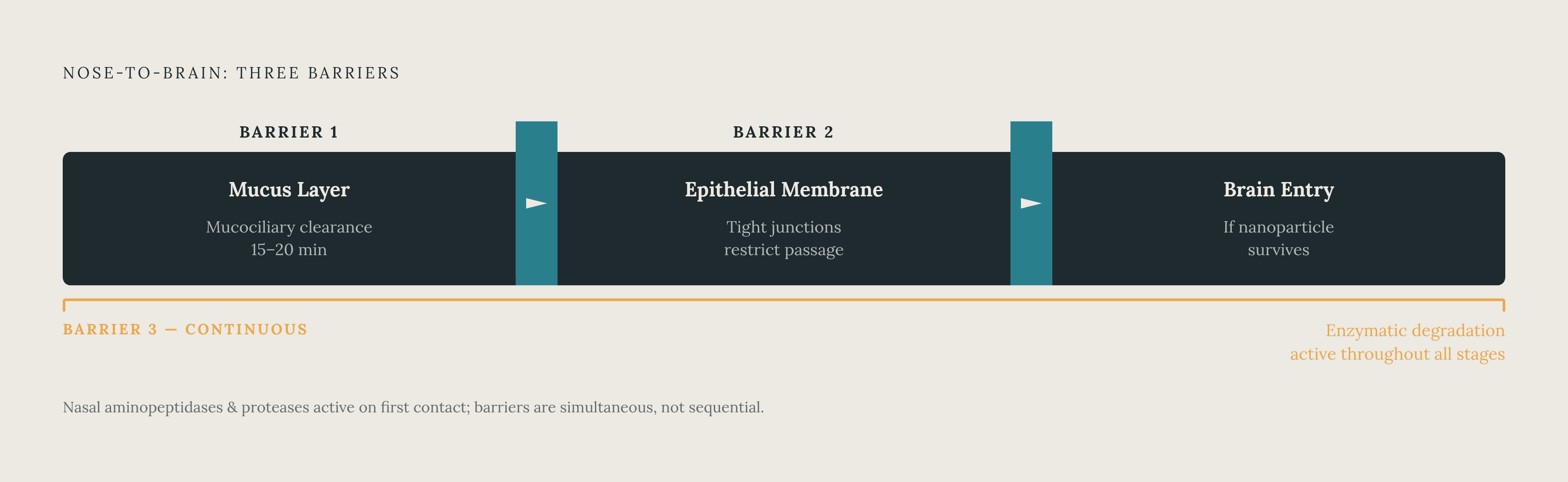
Barrier 1 is the mucus layer, which acts as a physical trap and chemical filter. Its gel network entangles large or charged molecules, while mucociliary clearance sweeps the nasal cavity clear within 15–20 minutes of administration. Barrier 2 is the epithelial membrane and its tight junctions, which restrict passage between cells while cell membranes impede passive entry by hydrophilic peptides. Barrier 3 is enzymatic degradation in the mucosal tissue, where proteolytic enzymes cleave peptide bonds.
A peptide that escapes mucus still faces the epithelium, and one that crosses it can still encounter enzymes in the submucosa. Although passage through these barriers can be described in three stages, enzymatic attack begins immediately on contact. The third barrier is therefore active during transit through the first two.
Why peptides make this barrier problem especially acute
Peptides combine the properties that make this route difficult. Their molecular size can hinder passage through mucin pores, while their charges can promote binding to mucin fibers. Their hydrophilicity also works against passive diffusion across epithelial cell membranes. Meanwhile, their amino-acid backbone provides the bonds that nasal aminopeptidases and proteases cleave.
GLP-1 peptides illustrate why overcoming these obstacles is scientifically consequential. GLP-1 receptors occur in the brain’s mesolimbic system, which governs reward and motivation, and in areas relevant to neurogenesis and inflammation. Brain-targeted delivery therefore has a mechanistic rationale. That rationale is not evidence that intranasal GLP-1 treatment has established clinical efficacy.
Systemic exposure can switch on peripheral receptors and play a part in gastrointestinal side effects, including nausea. Side effects account for roughly 14–28% of GLP-1 therapy stoppages in real-world practice. Could a brain-directed route increase CNS exposure while reducing that peripheral burden? To test that possibility, a carrier must get past all three barriers and keep the peptide intact as it moves through them.
Engineering through the mucus layer — surface PEGylation and mucus-penetrating particle design
Mucus is a selective gel. Mucin fibers contain negative charges and hydrophobic domains that can bind positively charged particles or exposed hydrophobic surfaces. Once adsorbed, a particle can remain trapped until mucociliary clearance removes it.
Polyethylene glycol coating, or PEGylation, offers a specific response. A dense, neutral, hydrophilic polymer brush sterically shields the particle surface, reducing electrostatic and hydrophobic binding to mucin. The particle can then diffuse through aqueous channels between fibers. Geometry remains an independent constraint, however. Nasal mucus pores are in the nanometer range, so knowing the pore-size constraint must precede choosing particle diameter.
Why not simply make the carrier more adhesive? Adhesion can extend residence time, but residence within mucus is not the same as access to the epithelium. A particle that remains stuck may be cleared with the mucus it binds. Mucus-penetrating design aims to reach the epithelial surface before clearance, making transport the useful endpoint. Hybrid architectures seek to combine rapid penetration with adhesion where longer contact becomes productive.
Engineering through the epithelium — mucoadhesion, tight-junction modulation, and chitosan carriers
Rapid movement through mucus must give way to sufficient contact for uptake across the cell layer. Paracellular transport passes between neighboring cells, through spaces normally sealed by tight junctions. Transcellular transport passes through cells, including by endocytosis or membrane fusion. Peptide-loaded nanoparticles are too large for simple passive paracellular diffusion even when junctions relax, making endocytosis a primary active pathway.
Chitosan offers a material response to this contact-and-crossing problem. This positively charged polysaccharide adheres to negatively charged mucosal surfaces and interacts with tight-junction proteins, extending contact while loosening paracellular seals. Such modulation is transient, reversible, and dose-dependent. Chitosan nanoparticles can also be formulated into hydrogels that gradually release drug-loaded particles after intranasal administration. These functions differ from a hydrophilic polymer coating’s role in limiting adhesion during mucus transit.
That difference creates an architectural tension. A surface suited to crossing mucus may not provide enough epithelial contact for uptake, while an adhesive surface can become trapped too early. Hybrid or switchable surfaces aim to use those properties one after the other. Crossing the membrane is not the endpoint, either. Surface ligands and charge densities can influence endocytic routing, including routes toward lysosomal degradation, while enzymes beyond the epithelium can still destroy exposed peptide cargo.
Engineering against enzymatic degradation — encapsulation as a physical shield
Avoiding hepatic first-pass metabolism does not avoid enzymatic attack. Nasal aminopeptidases, proteases, and other hydrolytic enzymes can break down biological molecules locally, bringing the threat close to the point of administration. By enclosing the peptide inside a polymeric or lipid carrier, encapsulation places a physical barrier between the enzyme and the peptide backbone.
Protection depends on when that barrier releases its cargo. Premature release exposes the peptide to the same enzymes the carrier was designed to exclude. Controlled release aims to keep the peptide intact as it passes through the mucosa and release the drug once it is past the enzymes that threaten it. Liposomes, solid lipid nanoparticles, and nanostructured lipid carriers offer lipid-based approaches that can support cellular uptake before release.
The principle extends beyond polymers and lipids. The AuNR approach proposed for intranasal acyl-ghrelin delivery, published July 2025, uses gold nanorods with high drug-loading capacity and structural rigidity. It demonstrated brain delivery with minimal systemic exposure, illustrating the potential of an inorganic carrier platform. Material choice alone does not settle the design, however. The same architecture must preserve its cargo while negotiating mucus and epithelial transport, so protective performance cannot be optimized independently of surface behavior.
Why all three solutions must be integrated into a single nanocarrier architecture
Mucus penetration is insufficient if epithelial uptake fails, and successful uptake cannot rescue cargo already degraded. Because the barriers act at the same time, the carrier must protect the peptide while its surface changes roles along the route. The useful unit of design is therefore the complete nanocarrier architecture.
Switchable surface chemistry makes that requirement concrete. A PEGylated shell that detaches at the epithelial surface could expose a mucoadhesive underlayer, separating the functions of penetration and attachment. Hybrid approaches also include mucoadhesive powders containing mucus-penetrating nanoparticles and in-situ gels with engineered diffusion pathways. These are strategies for reconciling competing demands. Their value depends on whether the functions occur in the right sequence.
MetP Pharma’s 2025 preclinical study in rats showed that its intranasal semaglutide formulation produced brain-to-plasma ratios consistently greater than 1. That finding supports the possibility of shifting a GLP-1 peptide’s distribution toward the CNS, without establishing human performance. Winterdahl et al.’s 2025 first-in-human PET study using ¹³N-labeled oxytocin separately demonstrated that an intranasally administered peptide can reach human brain tissue. Neither result alone validates every element of an integrated nanoparticle system, but together they support pursuing the distribution goal and the anatomical route.
What proof-of-concept evidence currently shows and where the translation gap remains
Preclinical advances show improved brain targeting, protection from enzymatic degradation, and controlled release with engineered nanocarriers. Those are meaningful delivery outcomes. They do not establish that a formulation will produce the required human CNS pharmacokinetics or improve a neurological condition. Likewise, the human PET finding establishes peptide transit.
Manolopoulos et al.’s 2025 meta-analysis found that GLP-1 receptor agonists did not improve memory and cognition in Alzheimer’s disease compared with placebo. Evidence for broader cognitive benefits was of low-to-moderate certainty. This is an important limit on the clinical argument. Inadequate CNS delivery from systemic injection may contribute to heterogeneous outcomes, but the finding does not establish delivery as the cause or prove that intranasal administration would reverse it.
Translation also requires safety, manufacturing scalability, and regulatory readiness. A well-performing animal formulation is not yet an approvable, manufacturable human therapy. The unresolved work includes making the carrier’s behavior predictable beyond the experimental setting in which it first succeeded. That gap increases the value of accumulated nanoparticle IP and iterative engineering knowledge, because a single formulation result cannot answer every question about reproducibility, transport, and clinical deployment.
Why is nose-to-brain peptide delivery a platform problem, not a formulation problem?
A nanoparticle platform is a design space. It comprises materials, surface chemistries, and fabrication processes that can be adapted to different payloads while retaining the core functions of mucus penetration, epithelial crossing, and enzymatic protection. A new peptide can change size, charge, hydrophilicity, and susceptibility to degradation. Platform knowledge allows those changes to be addressed using accumulated principles.
This distinction extends beyond GLP-1 peptides to oxytocin, exendin-4, and other neurologically active payloads. Addiction, dementia, and seizure disorders are possible CNS uses for the route, though success in treating them has yet to be shown. Each still needs evidence that getting the drug there helps patients. Manufacturing and regulatory readiness must develop with the architecture, while artificial intelligence-driven formulation design remains an emerging optimization tool dependent on experimental data and foundational platform knowledge.
If brain-directed GLP-1 delivery can lower peripheral exposure while keeping the intended CNS effect, it could ease some of the nausea linked to treatment stoppages, and nasal administration avoids injections. That outcome must be demonstrated. Rational nanocarrier design is the prerequisite for viable nose-to-brain peptide delivery because sustained treatment begins with a delivery system that gets an intact drug to the intended tissue.
Sources
- Nanocarrier-based intranasal drug delivery for enhanced neurological disorders treatment
- Full article: Advances in mucoadhesive and mucus-penetrating materials, nano-formulations, and in situ gelling systems for nasal drug delivery
- Intranasal Nano-Delivery Systems: Emerging Strategies for Central Nerv
- Polymeric nanoparticles for efficient nose-to-brain delivery - Nanoscale (RSC Publishing)
- Navigating the Nose-to-Brain Route: A Systematic Review on Lipid-Based Nanocarriers for Central Nervous System Disorders
- Advancements in Nanocarrier Systems for Nose-to-Brain Drug Delivery
- Full article: Intranasal Nano-Delivery Systems: Emerging Strategies for Central Nervous System Disease Therapeutics
- Pharmacokinetics and Pharmacodynamics of Intranasal Solid Lipid Nanoparticles and Nanostructured Lipid Carriers for Nose-to-Brain Delivery