Nanoparticle Technologies Engineered Specifically for Large-Molecule Peptide Payloads on the Intranasal CNS Route
Matching particle design to the peptide decides nose-to-brain success.

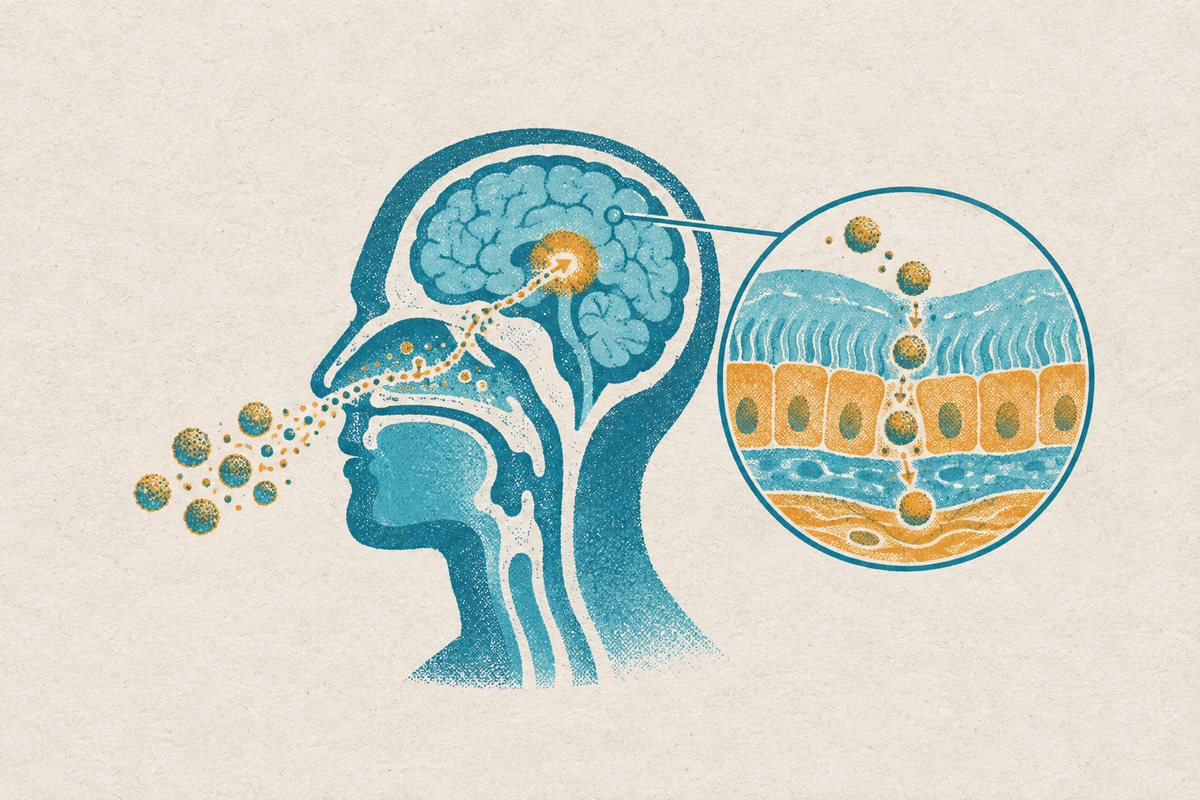
Nanoparticle nose-to-brain delivery for CNS peptide indications uses the olfactory and trigeminal pathways to bypass the blood-brain barrier for large peptides. For this to work, particles must be built to protect the peptide, move through mucus, and reach nerve-associated transport routes before nasal clearance removes them. The central engineering decision is therefore not which carrier holds the most drug, but which architecture solves those problems together for a particular payload.
Why the blood-brain barrier makes peptide CNS delivery a fundamentally different problem from small-molecule delivery
Peptides are usually too large, too polar, and too fragile to pass easily from the bloodstream into brain tissue. The blood-brain barrier excludes virtually all large molecules from meaningful brain exposure, so injection does not remove the central delivery constraint. Increasing systemic dose can amplify peripheral side effects without producing a corresponding increase in brain concentration.
This creates a distinction between a biological signal and direct drug exposure. GLP-1 peptides can produce behavioral and neurological signals while showing only limited brain penetration after subcutaneous or oral administration in preclinical studies. Those signals do not show that enough intact peptide reaches a proposed CNS target. When a peptide must act locally in brain tissue, the delivery architecture must get enough of it there, rather than rely on greater peripheral exposure to do so.
How the olfactory and trigeminal nerve pathways create a direct anatomical route from nasal cavity to brain
The olfactory pathway begins with receptor neurons in the olfactory epithelium, whose axons pass through the cribriform plate to the olfactory bulb. Connections onward to the piriform cortex, amygdala, and hypothalamus link this entry point to regions relevant to reward and satiety. The route bypasses the blood-brain barrier anatomically. It does not require a peptide to become capable of crossing that barrier from blood.
Intracellular axonal transport is slower, while extracellular movement through perineural spaces can deliver material toward the brain within minutes. These spaces connect with the subarachnoid cerebrospinal fluid space, helping explain rapid peptide appearance in CSF after some intranasal administrations. Rapid CSF appearance, however, is not itself proof of adequate exposure at every intended brain target.
The trigeminal nerve offers a second way in. It innervates the broader respiratory epithelium and projects toward the brainstem through the trigeminal ganglion. Standard sprays reach this nasal region more readily than the olfactory recess. Its accessibility makes it useful, although anatomical access and therapeutic delivery remain different questions.
The three barriers a nanoparticle must overcome before any peptide reaches the olfactory epithelium
Mucociliary clearance sharply limits the time available for absorption. Peptide size and charge can slow movement through mucus while nasal clearance removes deposited material. Protection must also begin immediately after deposition. Nasal proteases can cleave exposed peptide bonds before an intact payload reaches the epithelium, so extending residence without controlling degradation may simply extend exposure to enzymes.
In humans, the olfactory epithelium covers less than 10% of the nasal surface and lies in the uppermost recess, where standard sprays deposit poorly. Rodents have a substantially larger olfactory target, making successful rodent deposition an unreliable proxy for human delivery.
These barriers form a coupled engineering problem. A particle that adheres strongly but remains trapped in mucus may never reach the epithelial surface. A penetrating particle that releases an unprotected peptide too early may lose its payload to degradation. Even a stable particle that can move freely cannot use the olfactory route if the delivery device puts it elsewhere.
Why particle size is the first and most constraining design variable for nasal peptide nanoparticles
Mucus is a viscoelastic gel with a mesh structure that can physically trap particles. Perineural spaces impose another constraint on access to rapid extracellular transport. Size therefore determines which routes remain available. A particle that cannot enter those spaces cannot get in by holding more peptide or releasing it for longer.
Smaller is not automatically better, however. Reducing particle volume can restrict loading, especially for large, chemically modified peptides whose encapsulation must preserve their structure. The useful size window is consequently payload- and pathway-dependent, rather than a universal specification for all nasal nanoparticles.
Aminated chitosan nanoparticles containing the neuroprotective compound thymoquinone reached 135.9 nm, while chitosan-Poloxamer nanoparticles containing the peptide cetrorelix reached a mean diameter of 18.7 nm, with the different payloads limiting the size comparison. The first shows how a carrier can be designed, while the second gives direct evidence for a peptide.
How surface chemistry determines mucus penetration, epithelial adhesion, and nerve pathway entry
A hydrophilic or PEGylated surface can reduce interactions with mucin fibers and help particles diffuse toward the epithelium. That same low-adhesion surface can reduce epithelial contact once the particle arrives. Mucoadhesion creates the reverse trade-off. Chitosan and other polycationic surfaces extend residence and contact, but strong interactions can also immobilize particles in mucus before absorption occurs.
Chitosan adds a second mechanism through transient tight-junction opening, which supports paracellular permeation. Amination increases its electrostatic interaction with negatively charged nasal mucosa, and aminated chitosan formulations have shown enhanced permeability ex vivo. Cell-penetrating peptide conjugation offers another approach by promoting endocytic uptake, with improved brain bioavailability reported in animal models. None of these properties can be optimized independently of particle size and payload.
Positively charged materials can interact with negatively charged peptide domains, which may change secondary structure or cause the peptide to be released too soon. Design must therefore consider more than whether a surface is adhesive: where adhesion occurs, how strongly, and at what cost to intact peptide delivery. Much of the differentiation between platforms lies in these surface decisions.
Which nanoparticle platforms fit large-peptide nose-to-brain delivery, and what does each solve?
Chitosan-based particles primarily address clearance and epithelial access through mucoadhesion and transient tight-junction opening. The cetrorelix chitosan-Poloxamer system provides a peptide-specific example, with a reported drug targeting efficiency of 81.8 compared with 1.0 for subcutaneous administration in rats. Its Poloxamer component, Pluronic F-127, also supports thermosensitive gelling approaches that extend nasal residence. Charge remains a payload-dependent constraint. Large modified peptides with anionic residues require careful pH and charge-ratio control during encapsulation.
PLGA, or poly lactic-co-glycolic acid, emphasizes protection and sustained release through a biodegradable matrix. Its relatively inert surface does not inherently provide the mucoadhesion required for longer nasal contact. Chitosan-PLGA systems combine the protective matrix with an adhesive exterior, while PEG modification addresses mucus interactions.
Lipid nanoparticles offer membrane-like structures that support cellular uptake and suit amphiphilic or lipophilic peptide analogues. Large hydrophilic peptides present a harder loading problem. For those payloads, the appeal of a lipid carrier must be weighed against encapsulation performance rather than assumed from its usefulness for other molecule classes.
Serum albumin nanoparticles use an endogenous protein scaffold with high biocompatibility. In intranasal animal studies, these particles had higher brain-to-plasma ratios than intranasal or oral free-drug solutions, which makes them an option when the aim is to limit systemic distribution. Surface functionalization with receptor-binding peptides or antibody fragments could further support epithelial uptake. A favorable ratio still needs interpretation with absolute brain exposure, since relative targeting alone does not establish a therapeutic concentration.
Hybrid mucoadhesive systems separate functions across two layers. Small nanoparticles provide penetration and payload protection, while a thermosensitive or pH-responsive gel extends residence. A liquid-to-gel transition can support spray administration followed by retention at body temperature. The architecture is attractive only if the added retention preserves access to the epithelium.
What encapsulation efficiency and release kinetics mean specifically for large, chemically modified peptide payloads
Encapsulation efficiency measures how much payload enters the carrier, but it cannot alone establish whether that payload remains active. A high percentage of denatured peptide has little therapeutic value. Biological integrity must therefore accompany the loading measurement. This is particularly important for GLP-1 analogues, whose fatty acid chains and other modifications change molecular weight, hydrophobicity, and partitioning between aqueous regions and polymer or lipid matrices.
Release timing introduces a separate requirement. The cetrorelix system released peptide in an initial burst and then through sustained release, with cumulative release reaching 70–80% at 1440 min. Such a biphasic profile has a plausible transport rationale. Early release can exploit the short absorption window, while a protected reserve may support delivery over slower transport timescales.
Sustained release at the nasal epithelium requires particles to stay there, while release after transport requires them to have entered the relevant pathway. A long release curve in the laboratory does not show that particles are in either place. Clinical relevance depends on how much intact, active peptide reaches brain tissue over time.
How the nose-to-brain architecture reframes GLP-1 nausea as a delivery design problem rather than a receptor biology problem
When GLP-1 is given systemically, plasma exposure can be high while direct brain exposure stays low. That imbalance raises a testable question about nausea and gastrointestinal intolerance. Could part of the burden arise from where the drug goes, rather than being inseparable from its intended receptor action? The distinction is important because changing distribution would offer a different solution from changing the receptor interaction.
Treatment abandonment has been characterized as involving a large majority of obesity patients and nearly half of type 2 diabetes patients, although those descriptions alone cannot establish why individuals stop. Higher dropout in obesity is consistent with a tolerability burden, but it does not prove a delivery mechanism.
Reduced serum exposure in the cetrorelix nanoparticle work supports a pharmacokinetic premise whose relevance to reducing GLP-1 nausea remains to be demonstrated. Similarly, anatomical access to reward-related CNS regions does not establish selective therapeutic action. If adverse effects can be separated from benefit by redirecting exposure, nanoparticle design becomes a candidate solution rather than receptor modification or dose titration alone. That conditional claim requires direct testing with GLP-1 payloads.
The neurological indications beyond metabolic disease that the nose-to-brain peptide route opens — and why they require the same nanoparticle architecture
Brain GLP-1 signaling is also of interest for stroke, substance use disorders, Parkinson’s disease, and Alzheimer’s disease. Yet signals in these conditions do not show that the treatment works in humans. Parkinson’s provides a useful caution about interpretation. Multiple Phase 2 signals were followed by failure in the completed Phase 3 exenatide trial, leaving a gap that requires explanation rather than a delivery narrative treated as settled fact.
Incretyxbio has identified insufficient brain delivery as an explanation and is pursuing a preclinical program using Ophidion’s “trojan horse” BBB-crossing technology. That is a distinct strategy from intranasal bypass. It nevertheless illustrates the broader concern that systemic exposure may not establish the local concentration a proposed neurological mechanism needs. In Alzheimer’s, the biology itself is still in dispute, so better delivery cannot be assumed to settle doubts about the therapeutic mechanism.
MetP Pharma AG has reported preclinical brain-to-plasma ratios greater than 1 for intranasal peptide-based drugs and is advancing a pipeline targeting concussion, insomnia, ADHD, multiple sclerosis, and hypogonadism. These programs share requirements for mucus penetration, peptide protection, residence, and pathway access across indications, while outcomes remain to be established and a change in payload can still require changes in loading and surface design.
What translating these platforms from rodent proof-of-concept to human therapeutics actually requires
Human translation requires the device and formulation to work as one system. Particles need appropriate spray angle, droplet size, and delivery volume to reach the small, recessed olfactory region. Nanoparticle engineering cannot substitute for appropriate deposition. The trigeminal route is easier to reach and offers another way in, but entry through the brainstem must suit where the peptide needs to go.
Winterdahl et al.’s 2025 first-in-human PET study found detectable but low and variable brain uptake of intranasally administered peptides, supporting biological plausibility while leaving dependable therapeutic exposure to be established. Encapsulation offers mechanisms that could improve performance, including protection, longer residence, and engineered surface interactions, but their contribution must be demonstrated in humans.
No nose-to-brain peptide formulation has received FDA approval as of 2026. Oxytocin and insulin are in advanced clinical testing, while NPY remains preclinical or early-phase. MetP Pharma reports validation by independent institutions and 67 publications, most of them peer-reviewed, which gives its work a broader base than a single animal experiment but does not show approval or efficacy for a specific CNS peptide product.
The evidence must show how deposition in humans leads to intact peptide exposure and the intended therapeutic effect. The nanoparticle contributes to translation through an architecture that must compensate for the anatomy, clearance, and fragility that rodent proof-of-concept can leave unresolved.
Sources
- Nanoparticle-Enhanced Intranasal Drug Delivery: A Novel Strategy for Efficient Brain Targeting in Ischemic Stroke
- Comparison of Chitosan-Poloxamer Nanoparticles and Poloxamer-based In-Situ Forming Gel for Nose-to-Brain Delivery of Cetrorelix: In Vitro and Pharmacokinetic Studies in Rats
- Advanced intranasal peptide delivery systems for improved management of Alzheimer's disease - PubMed
- Navigating the Nose-to-Brain Route: A Systematic Review on Lipid-Based Nanocarriers for Central Nervous System Disorders
- Intranasal Nano-Delivery Systems: Emerging Strategies for Central Nervous System Disease Therapeutics - PMC
- Lipid and Polymeric Nanoparticles: Successful Strategies for Nose-to-Brain Drug Delivery in the Treatment of Depression and Anxiety Disorders
- Advancements in Nanocarrier Systems for Nose-to-Brain Drug Delivery
- Can Blockbuster GLP-1 Weight-Loss Drugs Also Protect Brain Health?