How Decades of Accumulated Nanoparticle Patents Separate Serious Nose-to-Brain Peptide Players From Platform Tourists
Why patent depth, not filing count, reveals real nasal-peptide platforms.

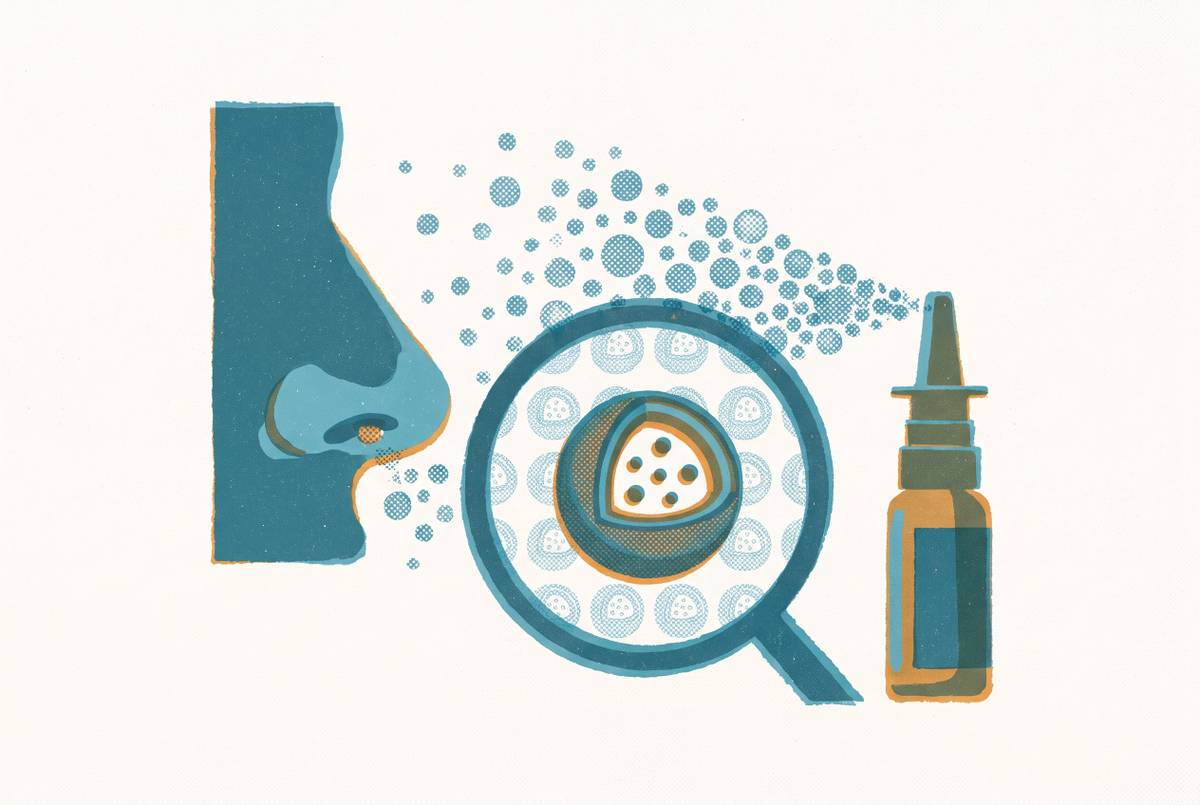
Nanoparticle nose-to-brain delivery for CNS peptide indications uses the olfactory and trigeminal pathways to bypass the blood–brain barrier, while engineered carriers protect and release peptide cargo. Its central challenge is integrated delivery engineering. A patent portfolio built over decades of biological validation says more about a platform's depth than isolated formulation filings do, though neither the age nor the number of patents proves clinical success.
Intranasal delivery is considered the most viable route for CNS-targeted peptides because oral and subcutaneous dosing both leave the blood–brain barrier in the way. Digestive proteases cleave oral peptides and the survivors are poorly absorbed, while subcutaneous injection avoids that loss but delivers the peptide systemically, where large molecules do not readily cross into the brain. The olfactory and trigeminal pathways offer a route around the barrier, and intranasal nanoparticles have been detected in the olfactory bulb within minutes of dosing. This remains a rationale and not a proven result, since intranasal peptides can still be absorbed systemically and human brain exposure has yet to be shown.
How does the olfactory–trigeminal route deliver peptides past the blood–brain barrier?
The olfactory nerve connects the nasal epithelium to the olfactory bulb, while the trigeminal nerve provides a parallel route toward deeper brainstem structures. These are distinct anatomical channels. Intranasally administered nanoparticles have been detected in the olfactory bulb within minutes of dosing. That observation establishes rapid access through a route different from absorption into blood followed by passage across the blood–brain barrier.
The distinction begins at the site of deposition. A nasal dose must reach tissue that provides access to these pathways. Transport then depends on how the carrier interacts with the epithelium and the pathways beyond it. Engineering for both channels therefore requires more than changing the dosage form of a systemically delivered drug.
Why is intranasal delivery more viable than oral or subcutaneous routes for CNS-targeted peptides?
For CNS-targeted peptides, conventional routes impose compounding obstacles. Digestive proteases cleave peptide bonds, and surviving molecules still face poor intestinal uptake. Subcutaneous injection avoids those digestive losses but delivers the peptide systemically, leaving the blood–brain barrier between the drug and its intended brain target. Large peptide molecules do not readily make that passage.
GLP-1 receptor agonists make this mismatch especially clear. Their established metabolic use involves peripheral targets, including the pancreas and gut, while systemic exposure contributes to nausea, vomiting, and gastrointestinal distress. A CNS-directed treatment has a different delivery objective. It needs adequate exposure in the relevant brain compartment without unnecessary peripheral exposure.
Nose-to-brain delivery offers a way around the blood–brain barrier, but it does not make every intranasal peptide dose work or rule out systemic absorption. The biological destination still has to be engineered. For appetite regulation, neuroprotection, or addiction circuitry, the route is therefore not simply a convenience preference. It helps determine where the peptide goes and what it can do.
The four engineering barriers that separate a viable N2B nanoparticle from a concept on paper
Mucociliary clearance limits the time available for absorption because the nasal mucosa moves foreign particles toward the throat within minutes. Mucoadhesion can prolong residence, but excessive retention must not prevent epithelial uptake. Chitosan is useful because it combines mucoadhesive and permeation-enhancing properties. The carrier must stay in the mucus and still be able to move into tissue.
Enzymatic protection introduces a second, coupled requirement. Nasal proteases can attack peptide cargo before transport occurs, so encapsulation must shield it during this interval. Changing surface chemistry to improve adhesion can also alter enzymatic exposure. Protection must therefore be assessed in the same design that establishes residence time and uptake.
Olfactory targeting adds a spatial constraint to those chemical requirements. The olfactory epithelium occupies a small, superior region of the nasal cavity, while deposition in inferior or middle regions can favor systemic absorption. Device design and particle aerodynamics must work together, because a well-protected peptide deposited at the wrong tissue has not achieved direct brain targeting.
Controlled release must then give the CNS the intended exposure. Burst release can waste drug and risk toxicity, while release that is too slow may fall short of receptor thresholds. Lipid composition can tune release kinetics in solid lipid nanoparticles and nanostructured lipid carriers. Yet particle size also affects loading, and release rate affects the residence time required. These interdependent constraints explain why a patent addressing one variable cannot establish a complete delivery platform.
Why nanoparticles are the enabling technology for N2B, not an optional enhancement
Nanoparticles make these requirements addressable within one engineered system. Encapsulation protects cargo, surface chemistry governs interactions with mucus and tissue, and the carrier architecture controls release. Nanoscale particles can undergo endocytosis and transport along olfactory axons. Their role is therefore functional.
Lipid carriers offer stability and controlled release, while chitosan-based polymeric particles offer mucoadhesion and enhanced permeation. Receptor-targeted surface modifications can improve olfactory specificity. Protein-based and inorganic particles extend the available design space, but material variety alone is not evidence of a platform.
That variety needs to solve the problems that come with each type of cargo. No single architecture optimizes every barrier for every peptide. A credible nanoparticle estate should therefore cover a range of material classes, surface modifications, and release mechanisms. Generic formulation coverage does not establish that breadth, and even broad nanoparticle claims need manufacturing and device integration before they describe a translatable system.
What the GLP-1 adherence crisis reveals about the cost of ignoring delivery
The 2025 cohort study in JAMA Network Open found that a majority of patients initiating GLP-1 receptor agonists discontinued within one year, with discontinuation extending to a substantial majority over two years. Pharmacy abandonment is also common, and gastrointestinal side effects are a leading reason patients stop. These are not marginal failures of otherwise effortless treatment.
Discontinuation data show that pharmacological efficacy alone is insufficient when patients cannot stay on treatment. For a chronic therapy, tolerability belongs within the therapeutic proposition.
Direct nasal-to-CNS transport seeks to reduce reliance on systemic exposure, which contributes to the gastrointestinal burden of injected peptides. Bypassing the blood–brain barrier is not identical to bypassing all systemic circulation. Lower peripheral exposure is a rationale for N2B development, while elimination of nausea and resolution of discontinuation remain unproven for an intranasal product.
The neurological frontier that injections cannot reach: GLP-1s, Alzheimer's disease, and addiction
GLP-1 receptors are expressed in the hippocampus, hypothalamus, and cortex, providing a mechanistic basis for investigating effects beyond peripheral metabolism. Preclinical studies show reductions in amyloid-β and tau pathology, inhibition of neuroinflammation, and enhanced synaptic plasticity. These findings concern disease-relevant biology. Systemic dosing also leaves uncertainty about adequate exposure at hippocampal and cortical targets.
Intranasal nanoparticle experiments address that uncertainty more directly. Poly(allyl succinate)–cell-penetrating peptide–GLP-1 nanoparticles produced rapid enhancement of learning and memory in Alzheimer's disease animal models within minutes of administration. Preclinical N2B work also reports preferential accumulation in relevant brain regions. These observations give researchers reason to study the route further, though how much drug reaches its targets in humans and how well it works remain open questions.
Addiction offers a related but less developed extension. GLP-1 receptors in the ventral tegmental area and nucleus accumbens participate in reward processing, and preclinical receptor agonism reduces drug-seeking behavior. Surface modification and release tuning could allow a shared nanoparticle architecture to support different CNS targets. A shared platform for dementia, addiction, and metabolic disease remains a hypothesis.
What the EVOKE trial failure teaches about the difference between mechanism and medicine
The EVOKE trials tested once-daily oral semaglutide against placebo in thousands of participants with amyloid-confirmed mild cognitive impairment or mild Alzheimer's disease. Semaglutide did not slow clinical progression on the primary endpoint, despite improvements in biomarkers.
Could inadequate delivery to the relevant CNS targets explain the gap? Oral delivery faces intestinal absorption variability and hepatic handling before the additional restriction imposed by the blood–brain barrier. Insufficient target-site concentration is therefore a plausible explanation, but the trial outcome does not establish it as the cause. Biomarker improvement cannot, by itself, distinguish inadequate exposure from an insufficient therapeutic mechanism.
The failure is consequently a caution for the field. It does not test the same proposition as intranasal nanoparticles designed for preferential hippocampal accumulation, but neither does it validate that alternative. Rodent accumulation and behavioral findings remain preclinical evidence. A properly engineered N2B platform must demonstrate human exposure and clinical benefit rather than treating delivery differences as an explanation that has already been proved.
How the current N2B patent landscape reveals who is building platforms and who is placing bets
The 2026 mapping of chitosan-based N2B patents highlights a landscape dominated by preclinical concept filings. Its scope is limited to chitosan. The distinction is important because a formulation claim may leave scalable synthesis, device compatibility, and biological validation largely unaddressed. Those missing layers separate a protected concept from a credible translation program.
Aptar Pharma's May 2026 entry illustrates coordinated filing across layers. Its three international patent applications for inhaled and nasal GLP-1 delivery covered spray-dried and powder processing technologies, preclinical pharmacokinetic evidence, and device compatibility. The reported preclinical improvement of up to 10× in systemic Cmax versus a comparable oral dose concerns systemic exposure. The example shows portfolio construction.
Foundational delivery IP can nevertheless have substantial financial consequences. Moderna's Form 10-Q states that the March 2026 settlement with Genevant Sciences and Arbutus Biopharma resolved all litigation worldwide between those parties. The substantial settlement illustrates the commercial significance of foundational lipid-nanoparticle claims. It does not make LNP litigation and chitosan-based N2B patents the same legal landscape, or establish the value of any particular nasal portfolio.
What decades of accumulated foundational IP actually look like, and why time is the variable that cannot be compressed
Accumulation has value when successive research cycles produce complementary claims. Work on a formulation makes animal studies possible, those studies show where it falls short, and further work yields new designs and validation data. Each cycle takes years. A new round of applications cannot recreate a 30-year biological validation record.
This is the structural advantage available to a university spinout translating a long academic research program. Its estate may link carrier chemistry to processing, surface modification, release control, and evidence from work across CNS indications. The advantage comes from those connections. Even a large set of closely related formulation claims would cover less of the engineering.
Time also needs careful interpretation in a legal assessment. A long research history does not prove that every foundational claim still has value in the market, and owning patents alone does not establish freedom to operate. Technical depth built over time makes a stronger case when the relevant claims and data back it up. Research time cannot be manufactured retrospectively, even when a new entrant can fund an ambitious development program.
A small group of concept filings made during heightened GLP-1 interest may represent a product bet. The portfolio has yet to demonstrate the manufacturing, device, and validation coverage needed for broader translation.
How to read a nanoparticle N2B patent portfolio as a signal of platform credibility
For clinicians, investors, and scientific peers, the practical test begins with coverage of the four engineering barriers. Does the estate address clearance, enzymatic protection, olfactory targeting, and controlled release across more than one carrier architecture? Separate patents for unrelated solutions do not by themselves show that a system can perform all four functions at once.
Scalable synthesis must keep size distribution, surface chemistry, and drug loading consistent, and device characterization must show how the formulation behaves during delivery. Aptar's coordinated filings illustrate why hardware compatibility deserves separate scrutiny. A formulation that has not been characterized in its delivery device leaves a central translation question unanswered.
Finally, the record should connect foundational claims to biological validation over time and across relevant models. When did the research begin, what did each study show, and do the claims cover a range of CNS indications or just one peptide–disease pairing? Chronology is useful only with that supporting evidence. As N2B GLP-1 development attracts more entrants, this framework will become more useful for distinguishing an accumulated engineering platform from an isolated position in a promising field.
Sources
- Nanocarrier-based intranasal drug delivery for enhanced neurological disorders treatment
- Full article: Can nanoparticle-based intranasal delivery systems revolutionize treatment of central nervous system diseases?
- Nanotechnology for enhanced nose-to-brain drug delivery in treating neurological diseases - ScienceDirect
- Biopolymer Nanoparticles for Nose-to-Brain Drug Delivery: A New Promising Approach for the Treatment of Neurological Diseases
- Chitosan-Based Nanoparticles for Nose-to-Brain Drug Delivery: A Real Path toward Effective CNS Therapy?
- Chitosan-Based Nanoparticles for Nose-to-Brain Drug Delivery: A Real Path toward Effective CNS Therapy? - PMC
- Intranasal Nano-Delivery Systems: Emerging Strategies for Central Nervous System Disease Therapeutics - PMC
- Navigating the Nose-to-Brain Route: A Systematic Review on Lipid-Based Nanocarriers for Central Nervous System Disorders