Why Academic Spinout Patent Depth Determines Intranasal Peptide Pipeline Viability
Robust patent portfolios signal whether spinouts have solved intranasal peptide delivery.

Intranasal peptide pipeline viability depends on protecting the delivery architecture alongside a promising molecule. Layered patents can show how an academic spinout has addressed clearance, degradation, transport and translation across candidates. For a university-derived nanoparticle IP platform for peptide delivery, that judgment needs evidence from the portfolio itself. Patent depth is a signal of accumulated engineering, and human delivery data remain necessary.
Why getting a peptide from nose to brain is harder than it looks
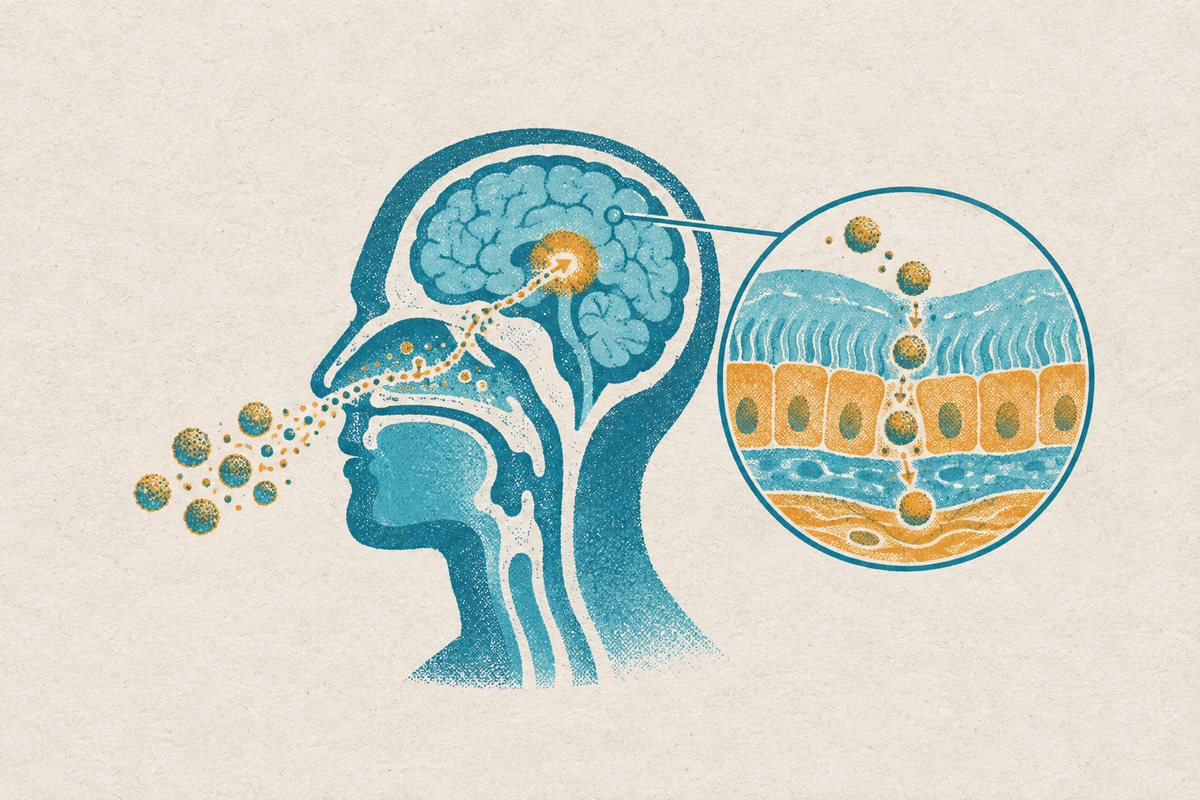
Two cranial nerve corridors connect the nasal mucosa directly to the brain, offering routes that bypass the blood-brain barrier. Their destinations differ. The olfactory pathway reaches the olfactory bulb and, from there, the hippocampus and cortex, while the trigeminal pathway reaches the brainstem. Those differences make route selection therapeutically consequential, because access to one CNS region is not interchangeable with access to another. For most peptides, extracellular perineural transport dominates, helping explain why some intranasally administered compounds appear in cerebrospinal fluid within minutes.
Mucociliary clearance removes most deposited material within 15–20 minutes, leaving unprotected peptides a narrow absorption window. During that window, the nasal mucosa also exposes them to a proteolytic environment that degrades peptide bonds. A peptide must therefore survive long enough to cross the epithelium and still be able to act once it gets there. Keeping a peptide in place longer cannot by itself stop enzymatic degradation, and protecting it cannot by itself ensure transport.
Anatomy adds a different kind of uncertainty. The olfactory epithelium occupies a large fraction of nasal surface area in rodents but less than a tenth in humans. A formulation’s dependence on access that its eventual patient does not share puts both dose adjustment and the transport mechanism itself in question. Approved intranasal drugs for epilepsy and migraine establish clinical precedent for nasal administration, but they do not establish therapeutic brain delivery for any given peptide.
Why nanocarrier engineering is the technical core that ties the solutions together
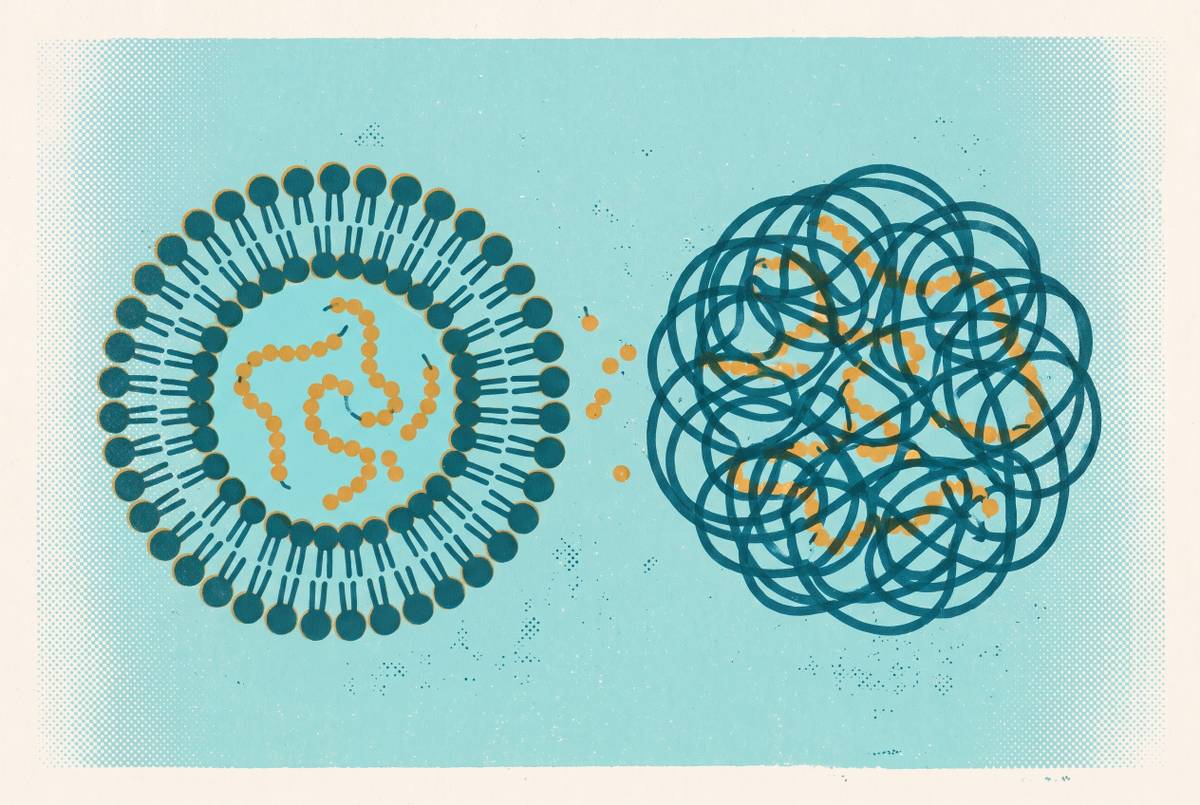
Because clearance, degradation and epithelial permeability act together, the delivery system must address them together. Nanoparticles, liposomes, nanoemulsions and thermosensitive gels offer different balances of protection, adhesion and release kinetics. Particle size, surface chemistry, mucoadhesion and release timing have to work as an integrated architecture, in which changing one parameter can disturb the others. The invention that solves these problems is therefore often the system whose parts work together, with more to it than any one ingredient.
Kamei et al. (2018) showed how a transport-enhancing component can change what a peptide formulation achieves. Co-administration of exendin-4, a GLP-1 receptor agonist, with the L-form of the cell-penetrating peptide penetratin substantially increased exendin-4 distribution throughout the brain. With supplemental insulin, the approach improved spatial learning enough to be measured in a model of severe cognitive dysfunction. Transport was consequential because it supported a biological response. Yet this does not make penetratin a universal solution, since the appropriate combination remains dependent on the peptide and indication.
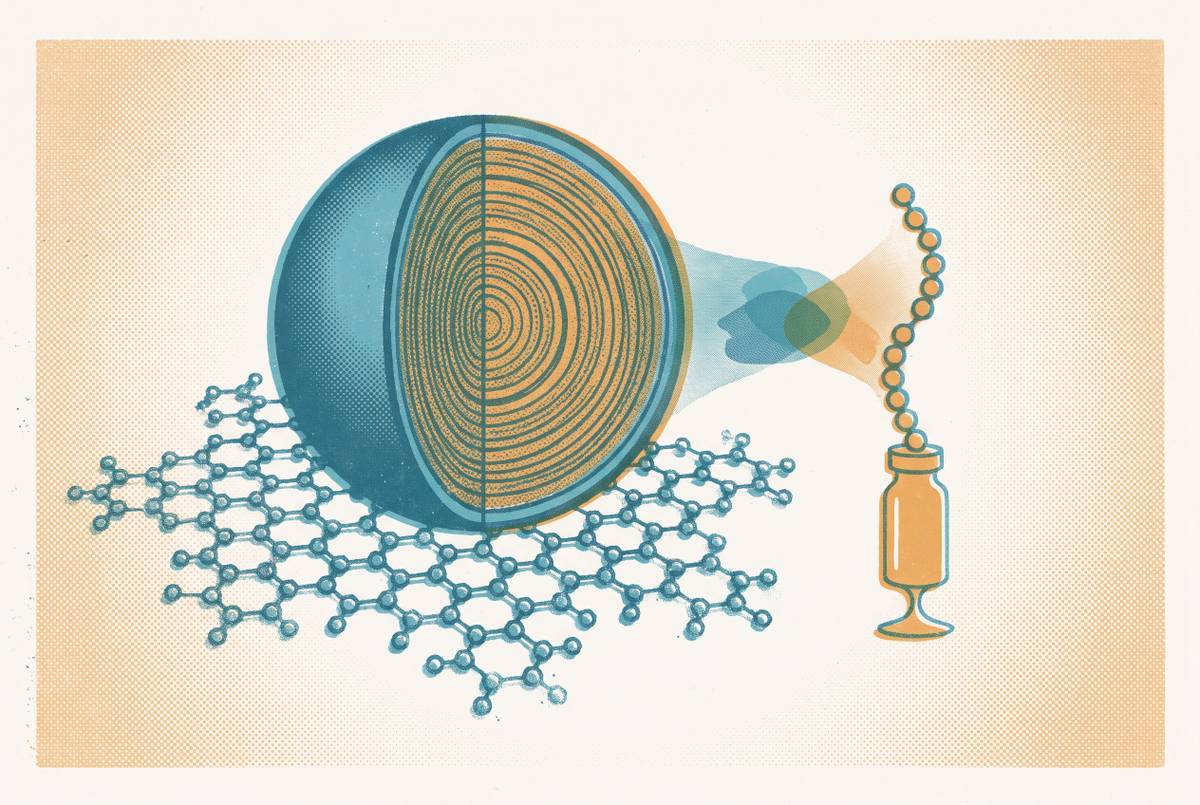
Han et al. (2025, King’s College London) demonstrated another architecture by conjugating acyl-ghrelin to gold nanorods through PEG linkers. The work delivered the peptide to the brain with its enzyme-mediated neuroprotective activity intact, so the engineering also preserved bioactivity. Delivery alone would have been an incomplete success. Chitosan, cell-penetrating peptides, tight-junction modulators and hybrid nano-gel systems provide distinct, potentially combinable ways to address the same interacting constraints. Knowledge of which combinations work accumulates through iterations. A platform can therefore contain engineering knowledge that a single published formulation does not reveal.
How the rodent-to-human translation gap turns a promising formulation into a fragile pipeline
The human olfactory epithelium is not merely smaller than its rodent counterpart. It sits in a recess that standard nasal sprays reach poorly, so deposition becomes an additional constraint on a formulation optimized for olfactory transport. Rodent efficacy can consequently overstate the contribution that pathway will make in humans. The candidate may still be biologically active even if it cannot get where it needs to go. That distinction is easy to miss when an animal response is treated as validation of the whole platform.
The trigeminal pathway offers more accessible entry for human delivery because it innervates the broader respiratory epithelium that standard sprays can reach. It is increasingly understood as a dominant route for intact nanoparticles in humans, making it a relevant alternative to an olfactory-centered architecture. This is not a universal ranking of pathways. Rather, it means that particle engineering and deposition must be judged against the human anatomy they will encounter as well as the animal model that produced the strongest response.
What evidence closes that gap? Human delivery and pharmacokinetic data can show whether the intended exposure is reached, while clinical experience so far shows that nasal administration is feasible but leaves therapeutic efficacy for a particular peptide unproven. A single-candidate spinout whose only architecture fails at this stage may have no protected fallback. A platform spanning multiple carriers and transport strategies has more room to adapt. That optionality is valuable precisely because preclinical success leaves a central uncertainty unresolved.
What GLP-1 biology reveals about why CNS-targeted delivery matters more than peripheral exposure
GLP-1 receptors are expressed in CNS regions involved in memory, reward and neuroinflammation. Brain GLP-1 signaling influences synaptic plasticity, insulin signaling and cellular energy management, giving direct CNS delivery a rationale beyond avoiding injections. The receptor is functionally active in these regions. If a neurological effect depends on engagement there, systemic exposure alone is not an adequate measure of whether delivery has succeeded.
The Kamei study helps make that distinction concrete. Intranasal exendin-4 co-delivered with cell-penetrating peptides activated hippocampal insulin signaling, measured through Akt phosphorylation, and the combination with supplemental insulin improved spatial learning in mice with severe cognitive dysfunction. When the same compound was given subcutaneously at the same doses, it did not have the same effect. That comparison suggests a CNS-specific mechanism at work in the model. It does not, by itself, establish a neurological benefit in humans.
The competing explanation deserves equal precision. Better vascular health and reduced systemic inflammation could account for some brain benefits attributed to GLP-1 receptor agonists, and some large clinical trials have not demonstrated cognitive benefit. Direct CNS engagement still needs to be tested. GLP-1 receptor agonists also modulate mesolimbic dopaminergic signaling, providing a plausible mechanism for addiction-reduction signals in observational data, but plausibility does not settle causation. Early research showing engineered GLP-1 derivatives moving through trigeminal neurons after nasal dosing supports biological compatibility with the route, leaving therapeutic sufficiency as the next question.
Why the adherence crisis in injectable GLP-1 therapy is a structural signal for delivery innovation
Roughly half of patients on injectable GLP-1 therapy discontinue within a year. That loss of sustained treatment creates a patient-experience problem that pharmacological potency alone cannot resolve. Its causes are mixed. Cost and insurance coverage are the reasons patients most often give for stopping, and side effects and inconvenience make it harder to keep going. Gastrointestinal effects, including nausea and vomiting, are the leading side-effect drivers, and the burden of injections compounds the difficulty for some patients.
A needle-free route directly removes the injection barrier, but its possible gastrointestinal advantage needs a more conditional argument. The mechanistic hypothesis is that if nose-to-brain pharmacokinetics allow effective CNS exposure with lower peripheral exposure, intranasal delivery may ease nausea that is caused in part by peripheral GI receptor activation. It also would not solve cost or coverage barriers. For potential neurological applications such as dementia risk reduction and addiction modulation, the need for sustained treatment makes these unresolved adherence questions central to development.
Landmark Medicines Ltd., based in Loughborough, UK, announced in September 2026 plans to progress its proprietary nasal platform toward a human volunteer study, with GLP-1 receptor agonists as the initial application. The company cited demand for non-injectable alternatives and a design protected by multiple patent filings. A planned study illustrates the move from a preclinical rationale toward testing whether a delivery platform can address a practical treatment problem. The commercial opportunity depends on that evidence.
What makes a spinout’s foundational nanoparticle IP strong beyond a single candidate?
A single formulation patent protects a different proposition from a layered delivery portfolio. If its scope is narrow, a competitor may be able to change the carrier material, surface ligand, cell-penetrating peptide sequence or excipient and operate outside it. Coverage across those elements can reduce that vulnerability. The distinction is not simply between fewer and more filings, but between protection of one implementation and protection of the shared architecture that makes several implementations possible.
Patents addressing nanocarrier geometry, surface chemistry, mucoadhesive strategy and transport-enhancing co-administration separately from the GLP-1 payload may support multiple peptide candidates. Landmark describes its approach as “formulation-agnostic” and protected by “multiple patent filings,” illustrating that design philosophy without establishing the strength of any particular claim. Filing breadth still has to correspond to useful technical scope.
For an academic spinout, that scope shapes the position from which it negotiates partnerships, licenses and acquisition discussions. Layered foundational IP can support a case for milestone structures and future platform applications beyond a transaction tied to one candidate. It provides three distinct forms of strategic support, including architectural protection, independence from an individual payload and evidence of iterative problem-solving. These functions are not interchangeable. A portfolio concentrated entirely on one molecule cannot stand in for protection of the delivery system.
Freedom to operate requires a further distinction. Owning patents on a platform is not, by itself, proof that the platform can be used without encountering other rights. Portfolio depth is therefore relevant to the architecture a spinout controls, but it cannot answer every legal or technical question about development. The evidence given also falls short of what is needed to rank one academic institution against others. Such a comparison would require the actual claims, their relationship to the platform and evidence that the protected solutions address its delivery constraints.
How accumulated nanoparticle IP signals that a spinout has worked through the translation problem rather than around it
A portfolio tells the most when it shows which engineering barrier each invention tackles. Particle architecture may help with clearance, surface modification may resist degradation, and transport-enhancing sequences may help a peptide enter while keeping its activity intact. Each layer has a technical purpose. Read this way, accumulated IP can document a history of problem-solving rather than merely the number of legal applications a team has filed. The inference is strongest when that history connects to the formulation being advanced.
The gold nanorod work illustrates why those layers emerge. Reaction conditions had to be optimized to limit multi-PEG substitution, preserve bioactivity and prevent nanoparticle cross-linking simultaneously. These were separate constraints within one delivery architecture. Their solutions illustrate the kinds of inventions that could underpin layered protection, although the research result alone does not establish a patent position. That distinction prevents a compelling publication from being mistaken for either commercial exclusivity or clinical readiness.
Human translation demands a similarly connected record. Device design may need to help reach the olfactory recess, while formulation work sets particle size for human mucosal conditions and pharmacokinetic modeling studies the exposure that results. Coverage spanning device, formulation and transport strategies can therefore signal preparation for the anatomical mismatch that threatens a rodent-optimized candidate.
When the same solutions work across peptides, later candidates can build on earlier work without having to repeat every engineering step. The potential advantage is lower adaptation cost and a shorter path for successive candidates, with candidate-specific testing still required. Patent breadth helps preserve the commercial value of that reuse. Publications and citations establish scientific credibility, while protection of the solved delivery problems supports a defensible development position. An academic spinout needs both to succeed, and human evidence must show whether its protected architecture can turn promising claims into a clinical pipeline.
Sources
- Nose‐to‐Brain Delivery of Acyl‐Ghrelin Peptide Gold Nanoconjugates for Treatment of Neurodegenerative Diseases
- Nose-to-brain drug delivery: from bench to bedside
- Effective nose-to-brain delivery of exendin-4 via coadministration with cell-penetrating peptides for improving progressive cognitive dysfunction
- Systemic and brain delivery of antidiabetic peptides through nasal administration using cell-penetrating peptides